How screen light can postpone the body’s night signal
Light reaches more than the parts of the eye used for seeing. Specialized retinal cells are especially responsive to blue-rich light and report its presence to the brain’s circadian clock—the system that coordinates daily patterns such as sleepiness and hormone release. That clock uses light as a cue for what time of day it is.
When the cue arrives late in the evening, the brain can interpret it as evidence that daytime is continuing. It may then delay the rise of melatonin, a hormone that helps prepare the body for sleep. The result is not simply that a screen makes someone feel alert in the moment: repeated or mistimed light can shift the timing of the body’s nighttime signal.
Brightness and timing matter, too
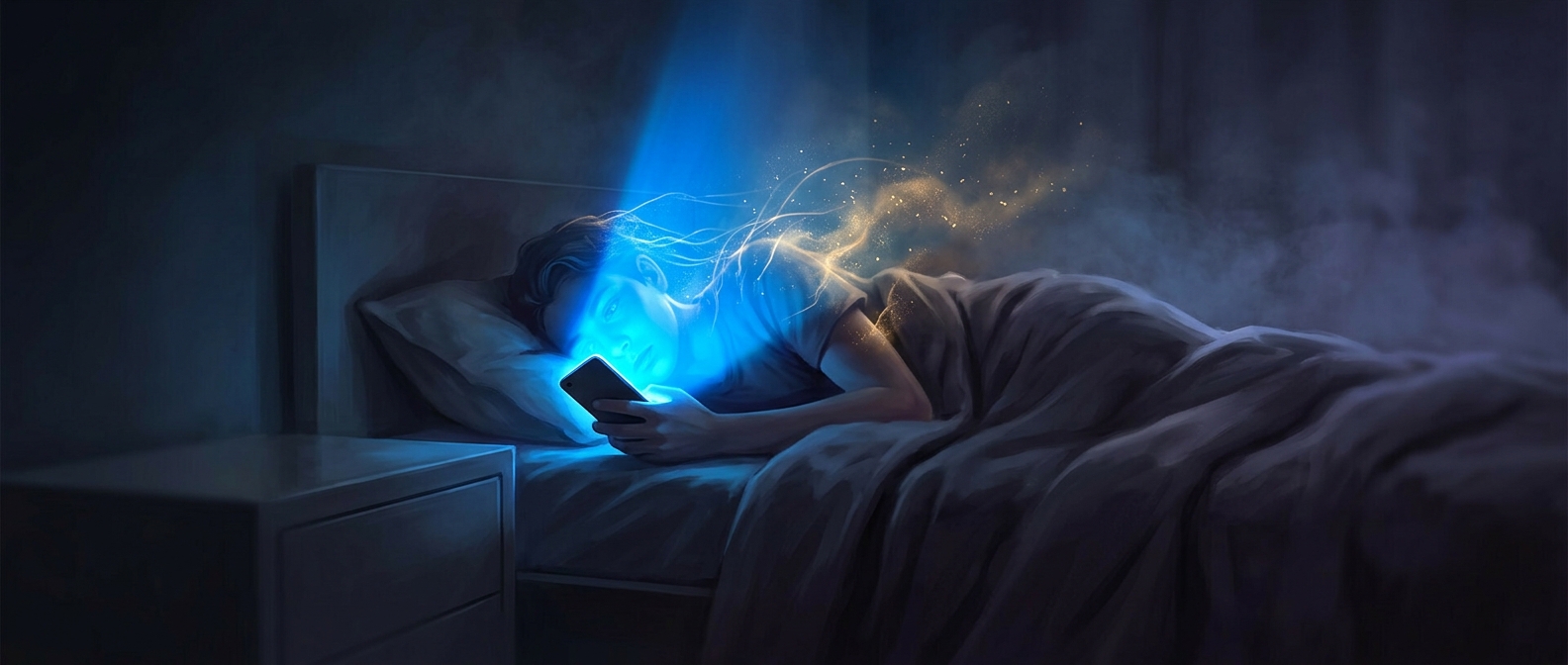
Blue wavelengths are effective at activating this pathway, but color alone does not determine the effect. How bright the screen is, how long someone looks at it, how close it is, and how sensitive that person is all matter. A bright screen viewed nearby in a dark room can be a stronger light cue than a dim display used briefly.
The clock also responds differently depending on when the light arrives. Light in the biological evening is more likely to push sleep timing later than comparable light received during the day. So a dark bedroom does not guarantee that the brain is receiving a nighttime signal: a luminous screen close to the eyes can still provide a meaningful dose of light at the wrong time.