How crossed springs change an off-center landing
A trampoline mat moves because its perimeter is connected to the frame by stretched springs. With springs running at an angle rather than straight outward, each spring pulls along its own line. That pull has two components: one helps support the mat vertically, while another can pull sideways toward the frame connection.
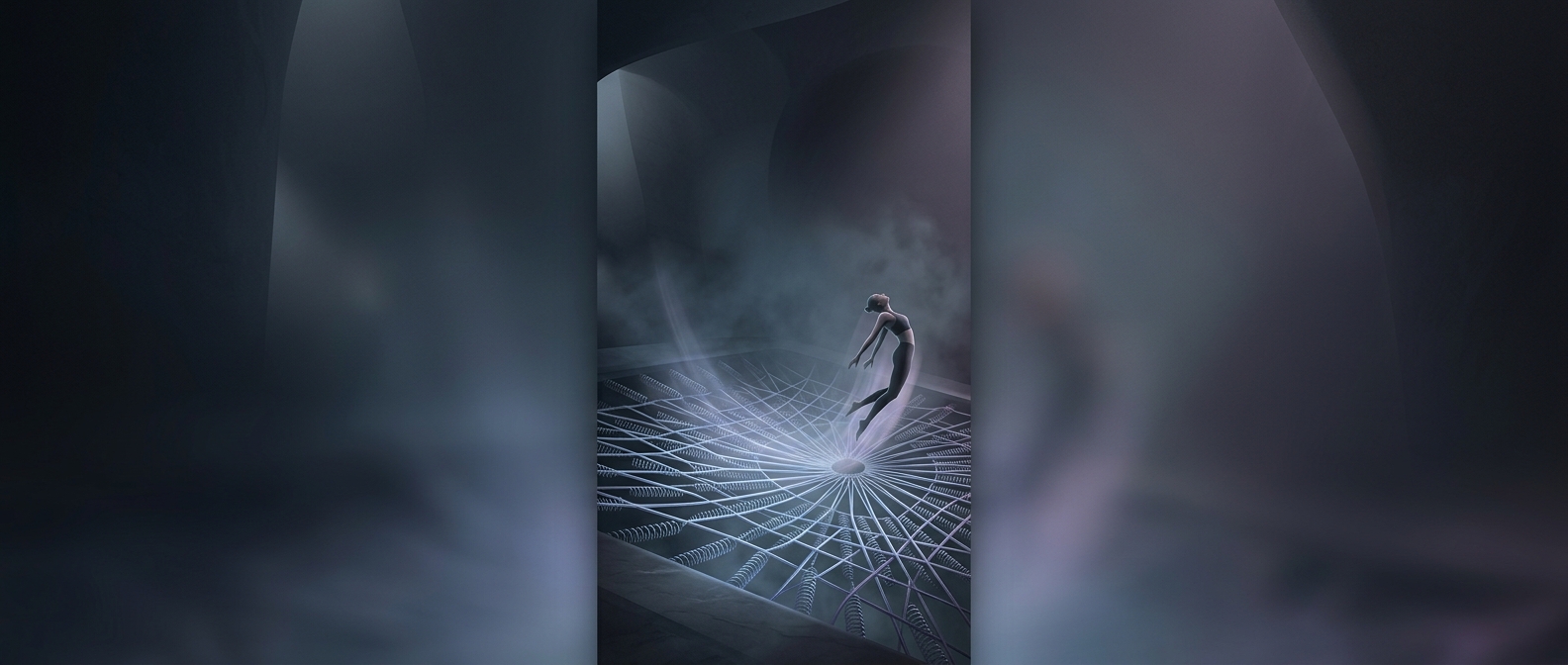
When the springs are arranged in crossing patterns, their angled pulls can share the load around the mat instead of acting only in the direction directly away from the nearest frame point. If a jumper lands off-center, the tension pattern changes across several parts of the mat. The resulting sideways forces can help guide the jumper back toward the middle as the mat rebounds.
Why the effect depends on the whole setup
The springs do not steer a person like a track. Their influence comes from how the mat stretches and recoils, and it depends on details such as spring placement, tension, mat stiffness, and where the jumper lands. A well-balanced arrangement can make the rebound feel more centered, but it cannot guarantee that every off-center jump will return neatly to the middle.
The practical design goal is to make the mat respond coherently across its surface: instead of one area yielding much more than its neighbors, tension is shared through the spring layout. That can make an uneven landing feel less likely to kick the jumper sideways—an important distinction when a trampoline’s bounce is shaped not just by its springs, but by the direction in which those springs pull.