Why a hollow clubhead can forgive a miss
At impact, the ball rarely meets the exact center of a clubface. A hit toward the toe or heel applies force away from the head’s center, creating a turning effect. The head can twist before the ball leaves the face, changing the direction and efficiency of the shot.
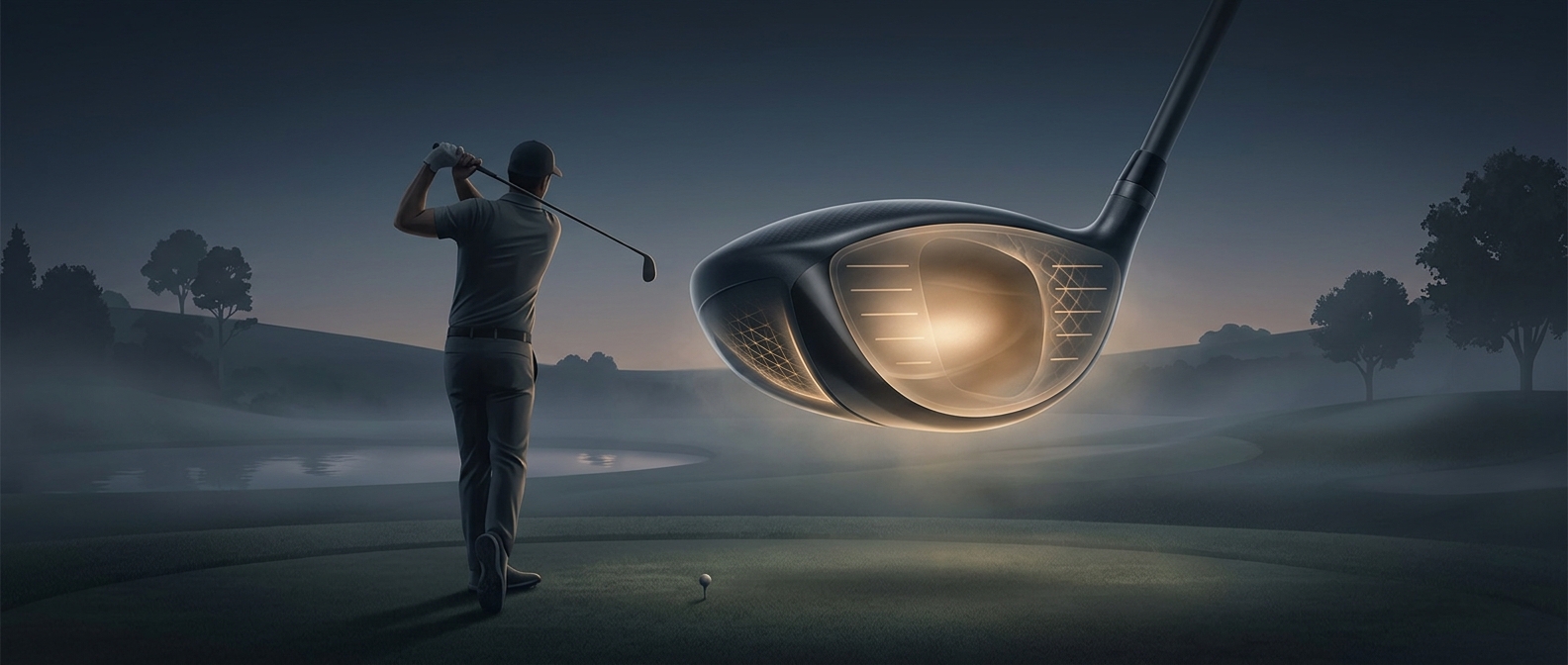
A hollow interior gives designers room to place more of the club’s metal near its perimeter instead of concentrating it behind the center. That arrangement increases the head’s moment of inertia—its resistance to twisting around its center of mass. With greater resistance, an off-center strike tends to rotate the head less, so the shot can retain more of its intended direction and speed.
What the empty space makes possible
The cavity is useful because it changes where the club’s weight can go; the air inside does not itself provide forgiveness. In drivers and other metal woods, a thin face and hollow shell allow designers to distribute mass around the edges and lower parts of the head. Some irons use a similar hollow-body construction, while others use a visible cavity or a solid design.
Those choices also let designers tune how the face bends at impact and where the head’s center of gravity sits. The result is a set of tradeoffs: a design optimized for stability or launch may feel or perform differently from one built to emphasize workability or feedback.
Forgiveness has limits
Perimeter weighting can reduce the penalty for a mishit, but it cannot make every strike behave like a centered one. A ball hit far toward the toe or heel can still lose speed and start off line. The practical advantage is more modest—and more useful: small misses are less likely to produce as much twisting, giving golfers a little more margin when contact is imperfect.