A tiny force at the start of planet-building
Planets began as dust and ice grains circling a young star inside a disk of gas. At that scale, gravity was a weak match for the motions of the surrounding gas: a grain could not simply pull distant grains together and hold them.
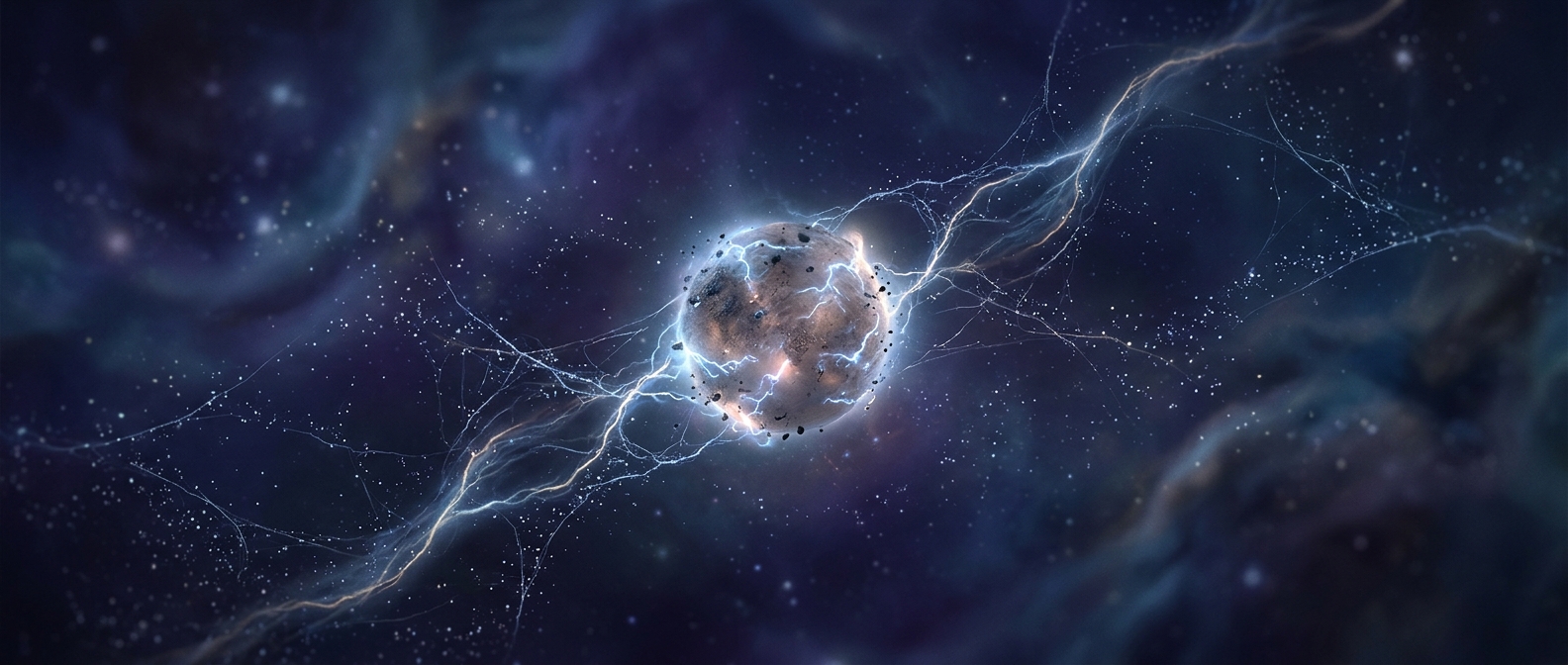
Collisions offered another route. When grains bumped and separated, they could exchange electric charge. If two grains acquired opposite charges, they attracted one another; even without a dramatic pull, electrical forces could help keep a collision from ending in a bounce. Repeated encounters could leave grains stuck together in small, irregular clusters.
From charged grains to growing clumps
This mattered because the first step was not making a planet, but making a grain large enough for later growth. Once a cluster formed, it could collide with other grains and clusters. As the pieces became larger, gravity increasingly helped them gather material, while motion through the disk brought them into further collisions.
Static electricity was not a complete planet-building system. Collisions could also make grains bounce or break apart, and the evolving disk involved gas, turbulence, and other forces. The electric charges offered a possible early assist at the stage when gravity alone had little grip—not a shortcut from dust straight to a world.
The consequence is a change in scale: a force familiar from rubbing a balloon on a sweater may have helped dust take its first steps toward becoming the much larger bodies from which planets could grow.