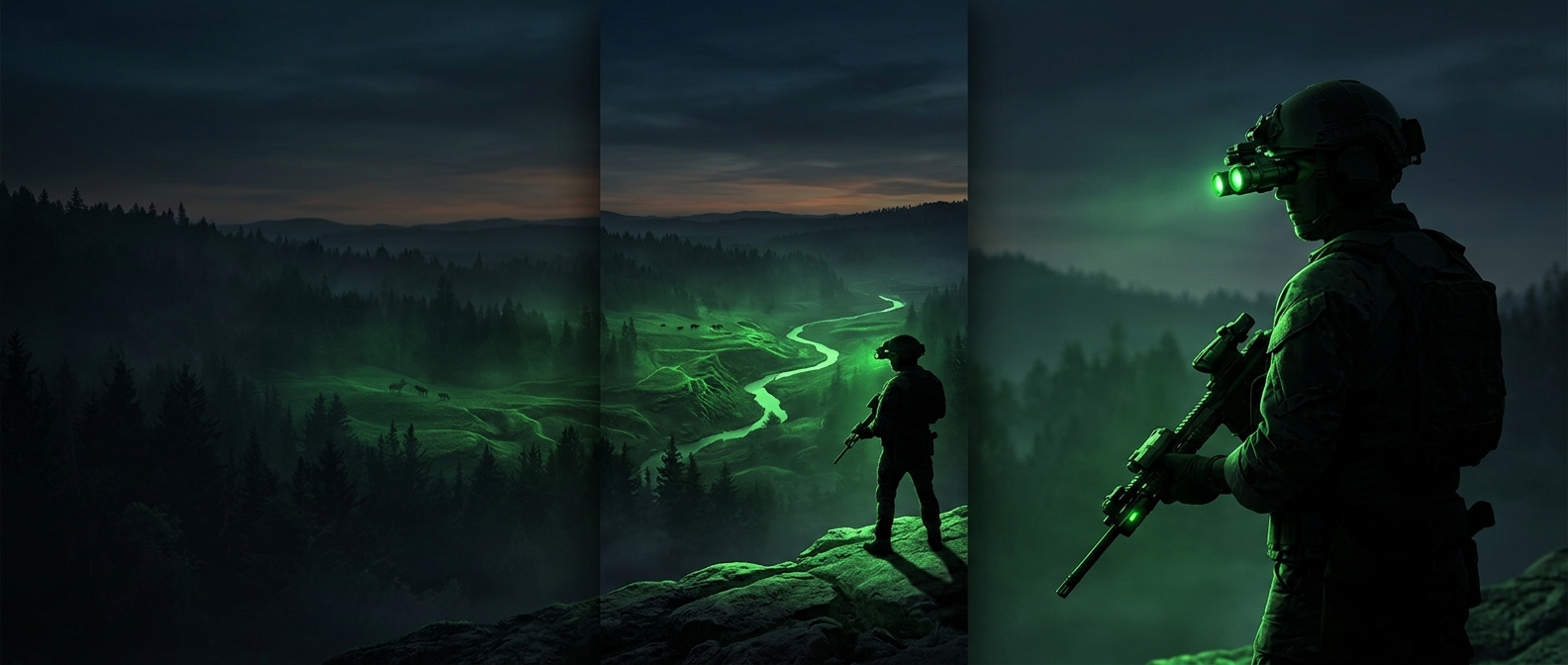
Two Ways to See in the Dark
Sam Fisher’s three-lens goggles draw on a real engineering challenge: seeing when ordinary vision fails. Thermal imaging and ambient-light amplification reveal different things. Thermal sensors detect infrared energy—heat emitted by people and objects—and turn temperature differences into a visible picture. Light-amplifying systems instead gather faint visible or near-infrared light and boost it, making a dim scene easier to see.
Combining the approaches in experimental equipment meant bringing distinct kinds of information into one viewing system. A warm person might stand out in a thermal view, while amplified ambient light could preserve more of the scene’s visible detail. They are not interchangeable modes of “night vision”; each depends on a different signal and offers a different picture of the surroundings.
From Experimental Gear to Game Icon
The real-world inspiration supplied the technological premise, not every detail of Fisher’s design. The three green circles became a memorable visual signature, turning a complex sensor system into something players could recognize at a glance. The green tint also echoes the familiar appearance of light-amplified night vision, even though thermal imaging works by detecting heat rather than simply brightening darkness.
The goggles’ famous whine belongs to the game, not the military equipment that inspired them. It gives the device an unmistakable sound in a medium where players cannot always see what their character is doing. That contrast is the useful distinction: the underlying idea came from experiments in sensing, while the lenses and sound made it legible as a piece of fiction.