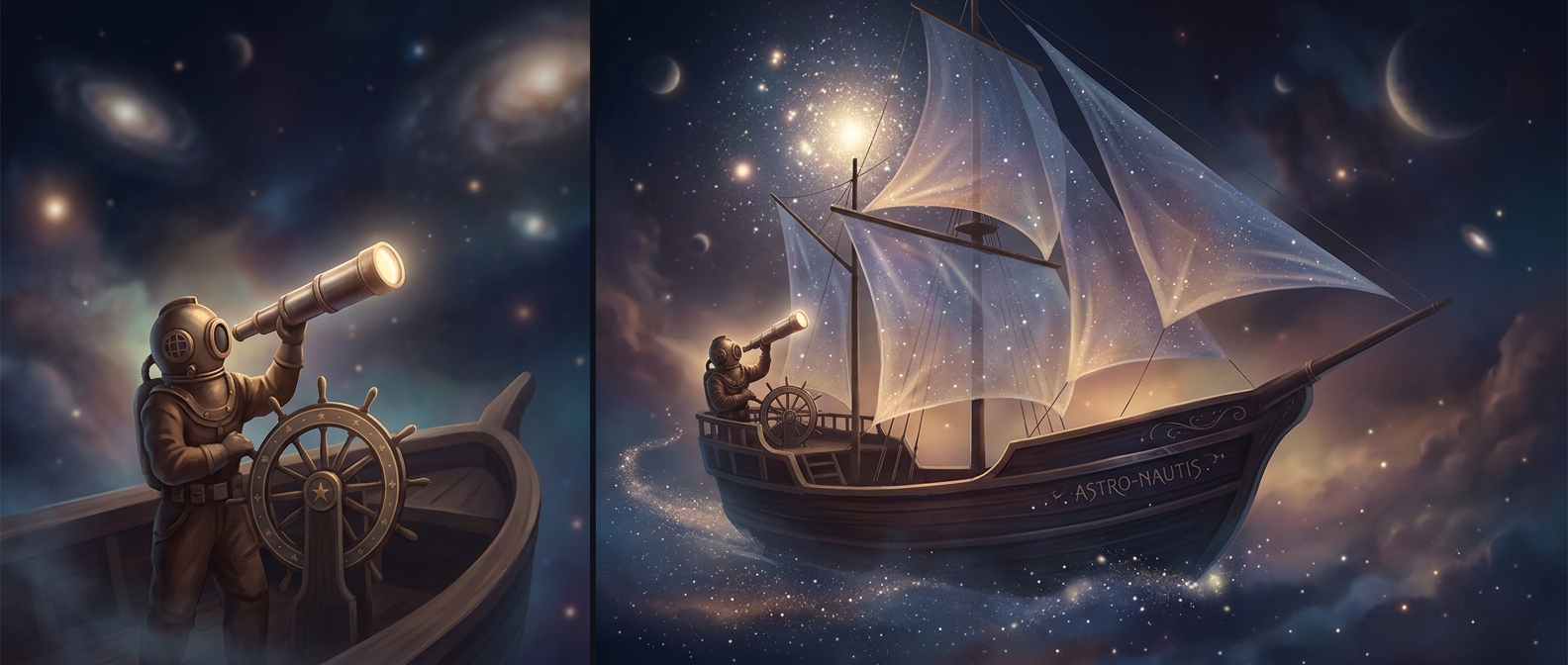
A sailor’s name for a journey beyond Earth
“Astronaut” joins the Greek astron, meaning “star,” with nautēs, meaning “sailor.” The second part belongs to a family of words that cast travel as a voyage: an aeronaut, for example, travels through the air. In “astronaut,” that old seafaring image is carried into a new setting—the region of stars.
The word is evocative, not a literal job description. Astronauts do not sail through space as ships sail across water. Their spacecraft follow trajectories shaped by gravity, and crews depend on launch systems, computers, and ground teams to plan and carry out a mission.
Why the metaphor fits
The comparison works because both kinds of travel involve venturing into an environment where the route must be carefully found and the vehicle carefully managed. Spacecraft can use observations of stars to help determine their orientation, while crews monitor systems and follow planned procedures. The resemblance is not that space behaves like an ocean; it is that reaching an unfamiliar place demands navigation and preparation.
Calling space travelers “sailors of the stars” therefore links modern exploration to a much older image of human voyaging. It makes a technical journey sound like an expedition—and gives the people aboard a name that suggests not just where they go, but the spirit of setting out.