Why a broken genome is not the end
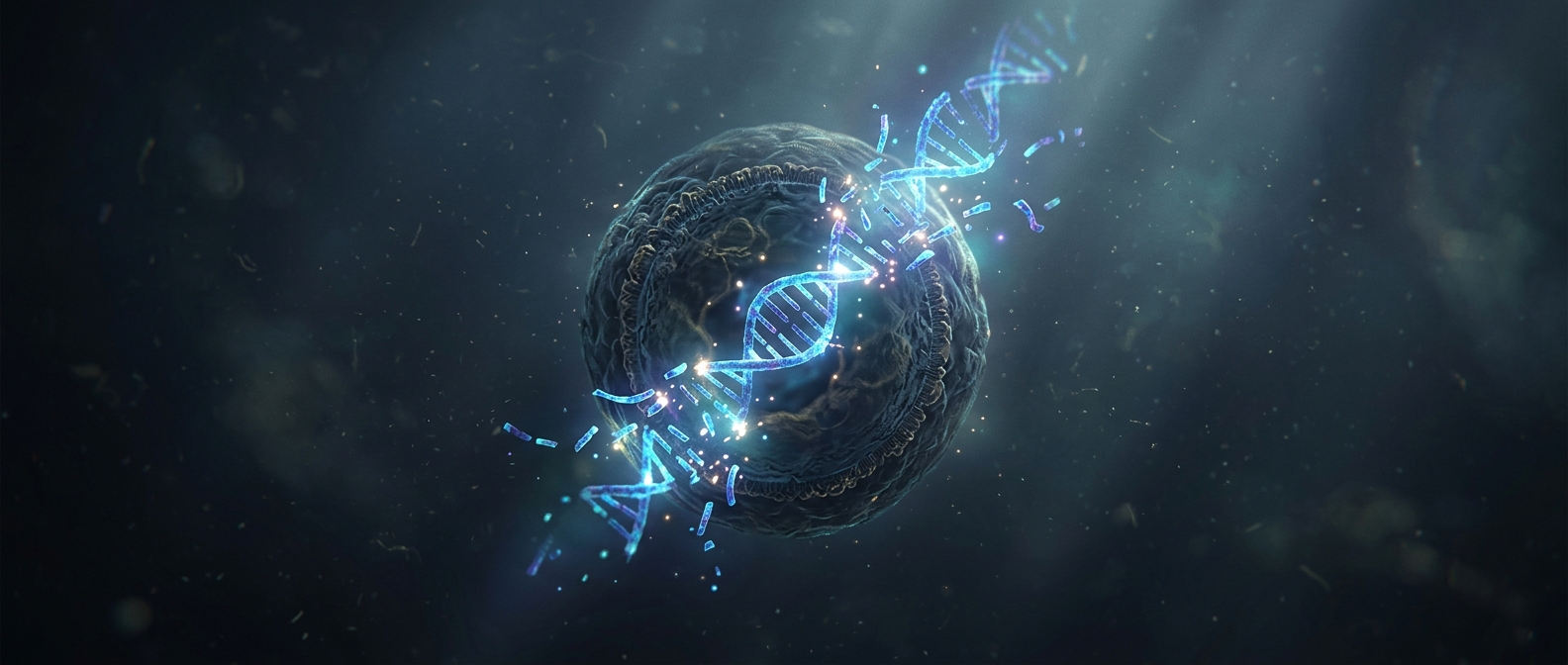
A bacterium’s DNA is its working set of instructions. If radiation or another damaging stress breaks that molecule into many pieces, the cell may still survive if it has intact copies of the same genetic information. Those copies provide something a lone, shattered genome cannot: reliable reference material.
Matching fragments to a template
The cell’s repair machinery first finds DNA pieces whose sequences overlap—short stretches of matching genetic “letters” that reveal which fragments belong together. It can then use an intact copy as a template, matching each broken region to its undamaged counterpart and rebuilding the missing sequence.
This is more than gluing fragments back into a line. The cell must identify the right matches, copy the correct information, and reconnect the chromosome without introducing fatal errors. Multiple copies make that possible because damage to one set does not necessarily destroy the instructions needed to repair it.
Repair depends on redundancy
The strategy is a biological form of redundancy: when one record is damaged, the others preserve the information. It does not make the bacterium invulnerable, and it cannot help if too many copies are damaged in the same places. But when usable templates remain, the cell can reconstruct a genome that looked irreparably fragmented.
That is the striking consequence: a chromosome can be broken into pieces without its information being lost, provided the cell still has intact copies from which to read it.