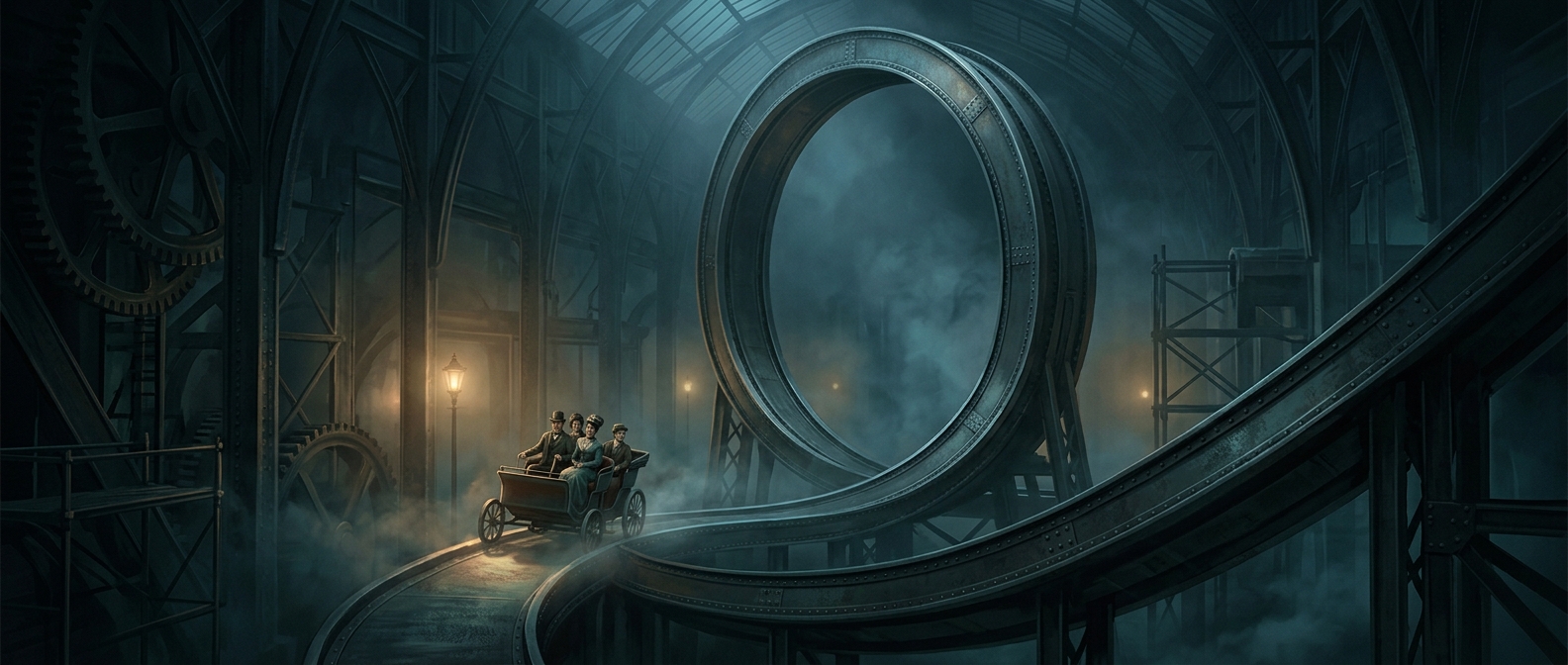
How a railway loop makes a climb manageable
A train gains height only as its track rises, and a steep track asks a locomotive to pull a heavy load uphill while keeping its wheels gripping the rails. Victorian engineers could ease that demand by making the route longer: instead of pointing straight up a slope, the railway curved around it, gaining height gradually over more distance.
The key measurement is the gradient—how much the track rises for a given length of track. Spreading the climb out reduces the gradient, making it more practical for a locomotive to haul a train without excessive strain or slipping.
The terrain set the engineering problem
A loop was not simply spare track laid in a circle. It had to fit the contours of the landscape while keeping curves broad enough for trains to negotiate. Where the route crossed itself, engineers could carry one section over another on a bridge or pass it through a tunnel. That let the railway continue climbing without resorting to a sharp, direct ascent.
These solutions traded distance and construction work for a gentler route. A loop could mean more track to build and maintain, along with costly structures where the land demanded them. But for a railway serving a steep region, the alternative might be a gradient too demanding for the trains of the time.
The result is a route that can look as though it is wandering away from its destination. In fact, each broad curve is doing practical work: turning horizontal distance into a controlled climb.