A visor solved a production problem—and became a point of view
In the original Halo, much of the action is seen through Master Chief’s eyes. That perspective made detailed facial animation less important during ordinary play: the camera rarely needed to show his face. In story scenes, meanwhile, a sealed helmet avoided the work of animating expressions and synchronizing mouth movements with dialogue—tasks that take time even when a character’s face appears only briefly.
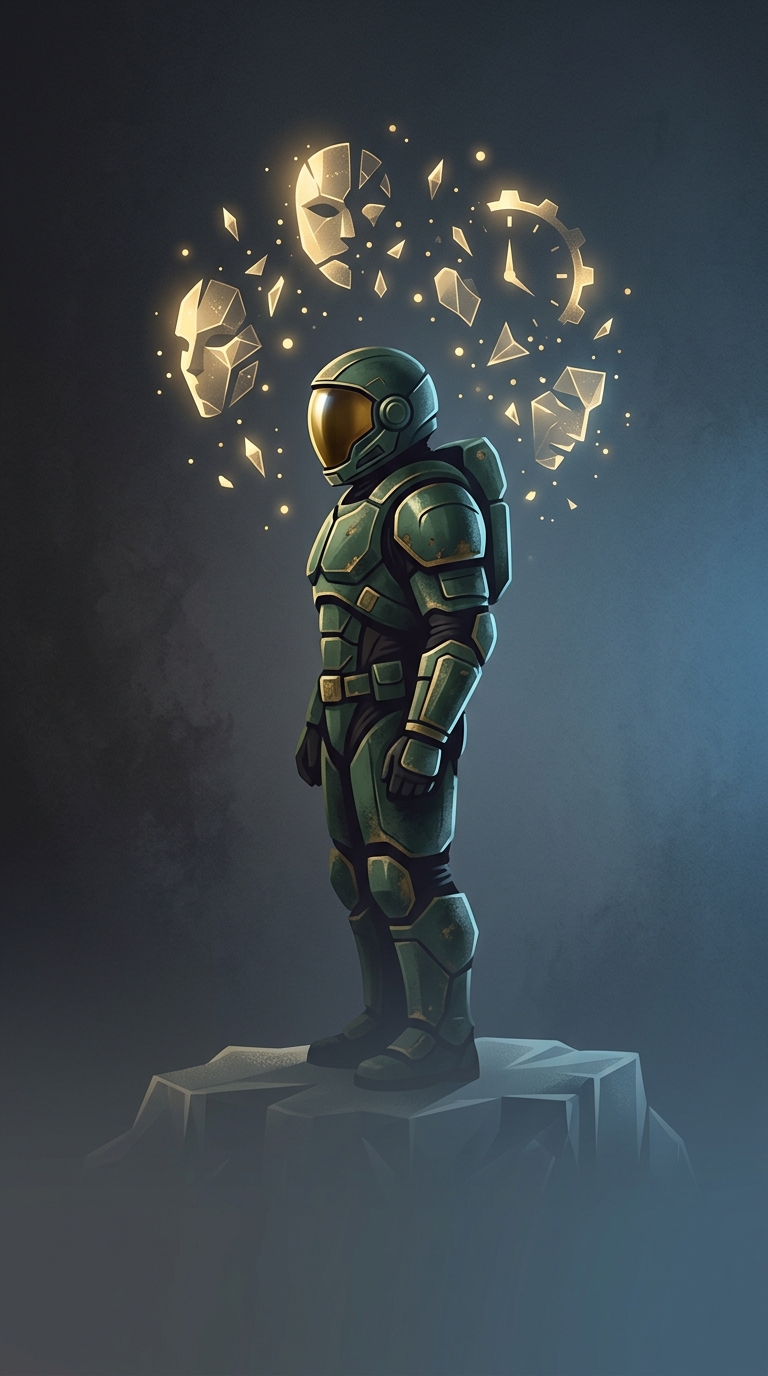
The armor therefore did more than conceal a character. It let the developers present a convincing soldier without having to build every scene around a fully expressive digital face. The green shell, reflective visor, and steady voice supplied a readable presence while leaving the performance to movement, sound, and the surrounding action.
The missing face made room for the player
Because players could not read Master Chief’s expressions, they had fewer visual cues telling them exactly what he felt. His restraint could register as discipline, loneliness, or simple toughness, depending on the scene—and on the player watching it. The first-person view reinforced that effect: players spent much of the game looking out from his position rather than studying him from the outside.
That does not mean the character was empty or that every player interpreted him the same way. It means the design left one especially personal feature—the face—unfixed. A practical limit on what the team could animate became part of how the hero worked: the visor hid the character from view while helping players occupy his place.