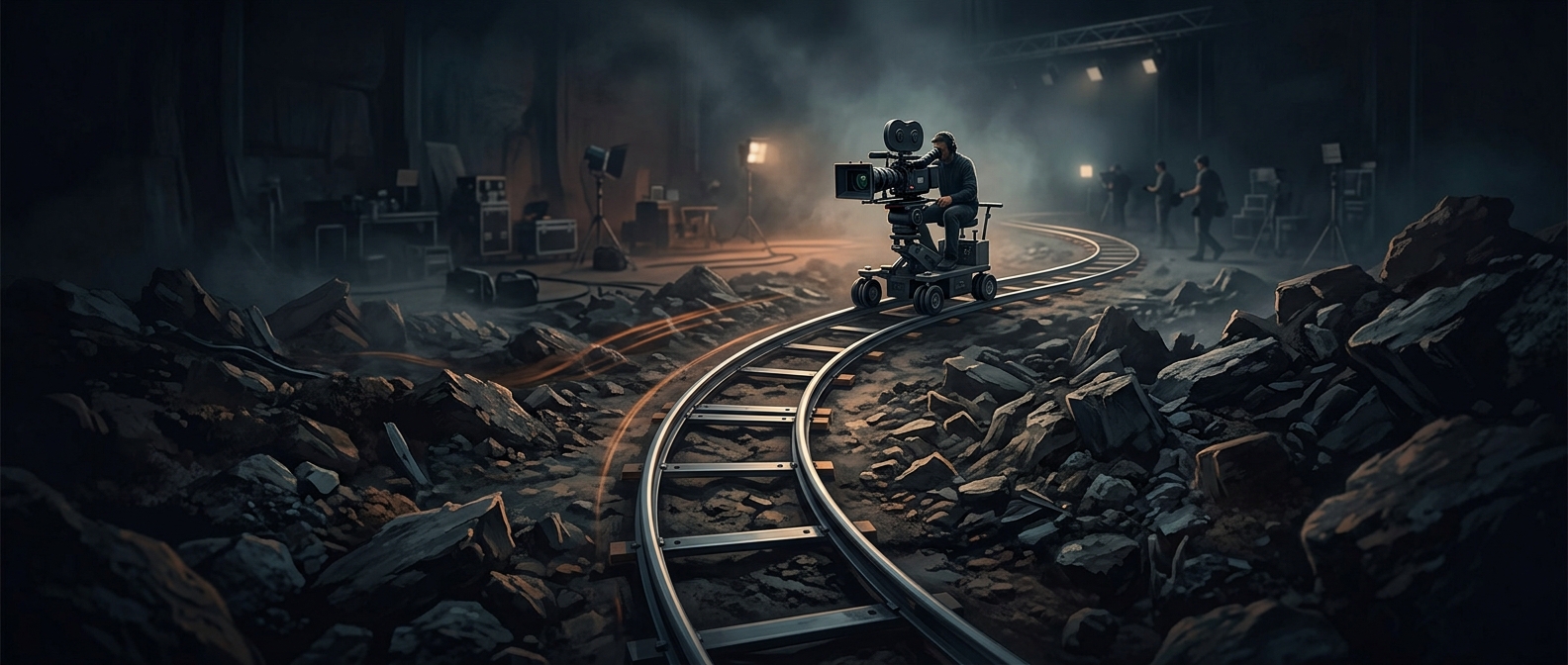
Why a Camera Dolly Needs Its Own Level Ground
A camera dolly is a wheeled platform that carries the camera—and often an operator or assistant—through a shot. Its wheels follow two parallel rails, turning a push into a controlled camera move. But rails laid directly over lumpy ground would inherit every bump: a wheel could rise or dip, making the frame wobble just when the camera is meant to glide.
Crews solve that by adjusting the track’s supports until the rails are stable and aligned. They check not only whether the track is level, but whether the rails stay at a consistent distance apart and meet smoothly at their joints. A small misalignment can become a jolt as the dolly rolls over it.
A Short Move Still Needs Careful Setup
The track may cross dirt, grass, or a carpeted floor, so the support beneath it has to suit the surface. On soft ground, a rail needs a firm base that will not sink under the cart; on a hard surface, the challenge may be preventing the track from rocking or sliding. The heavier the camera rig, the more important it is that the rails remain steady under load.
That preparation explains why a brief push-in can take more work than the finished shot suggests. The crew lays and adjusts the track, then moves the dolly along it at a controlled pace. The resulting motion shifts the camera’s position through the scene, changing how foreground and background objects line up—a depth effect a zoom alone does not create.
Smoothness Is Built Into the Route
A dolly move is therefore partly an engineering problem: the path must be predictable before the camera can make the movement look effortless. The rails do not erase the terrain; they create a stable route across it. When the setup is right, viewers notice the camera’s approach or retreat, not the uneven ground that had to be managed beneath the track.