A sculpture that took over a home
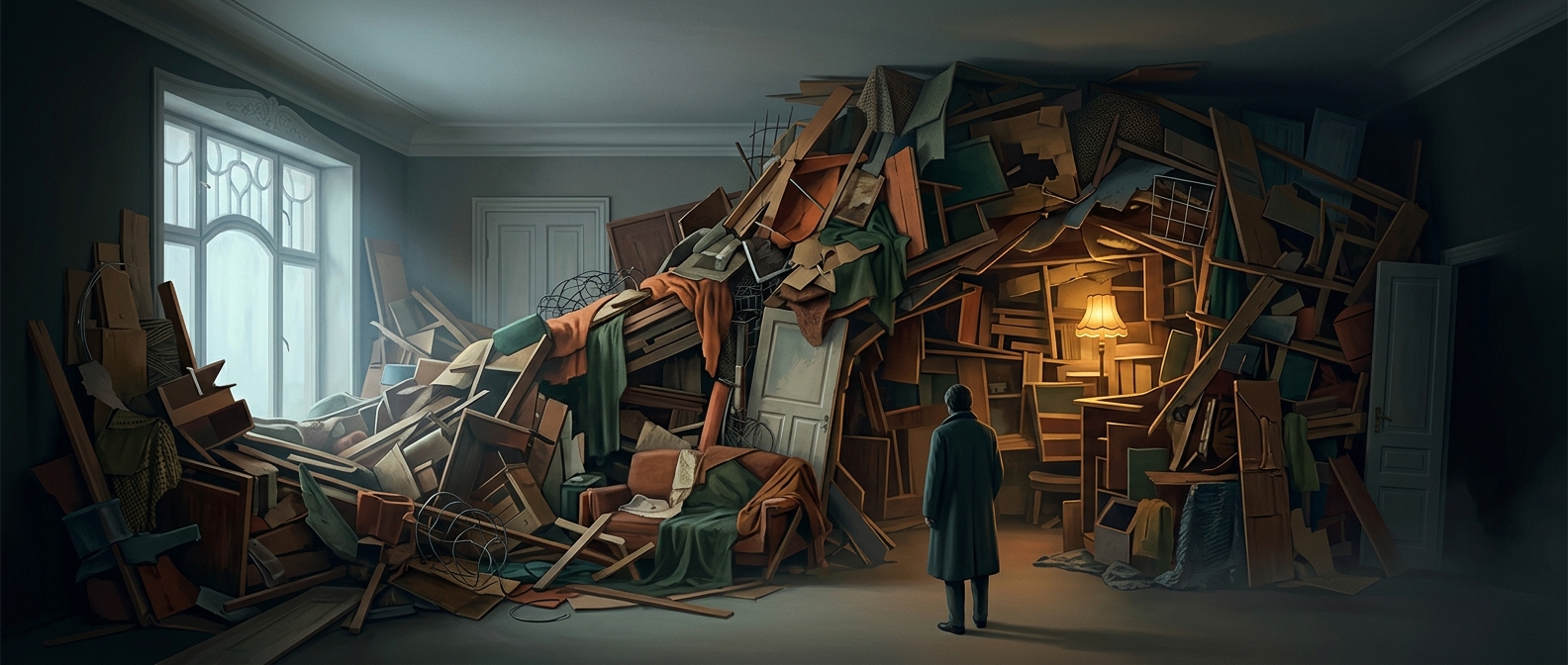
Kurt Schwitters’s Merzbau was not a freestanding monument placed in a room. It grew inside his house in Hannover, Germany, turning domestic space itself into part of the artwork. As he added materials over time, the structure spread through rooms and changed their shape, making it difficult to separate sculpture from architecture.
The objects mattered not just as unusual ingredients but as traces of ordinary life. Schwitters arranged fragments into built-up forms, openings and niches. A discarded ticket or broken object could become part of a larger composition, its everyday use giving way to a new role within the structure. The result was less like a display of collected junk than an environment continually reshaped by its maker.
An artwork with no final form
Schwitters developed the Merzbau over years, so it had no fixed version that could simply be finished and moved elsewhere. Each addition altered the setting around it. Visitors did not encounter one isolated object; they entered a work that had absorbed the walls and rooms they were standing in.
That dependence on a particular place also made the work vulnerable. The Hannover Merzbau was destroyed during an air raid in 1943. Its loss shows the consequence of Schwitters’s approach: because the artwork was built into a lived-in space, it could not survive as a single portable sculpture. What remained were records of a work whose full, room-filling form had vanished. The discarded fragments had become part of the house—and the house had become part of the art.