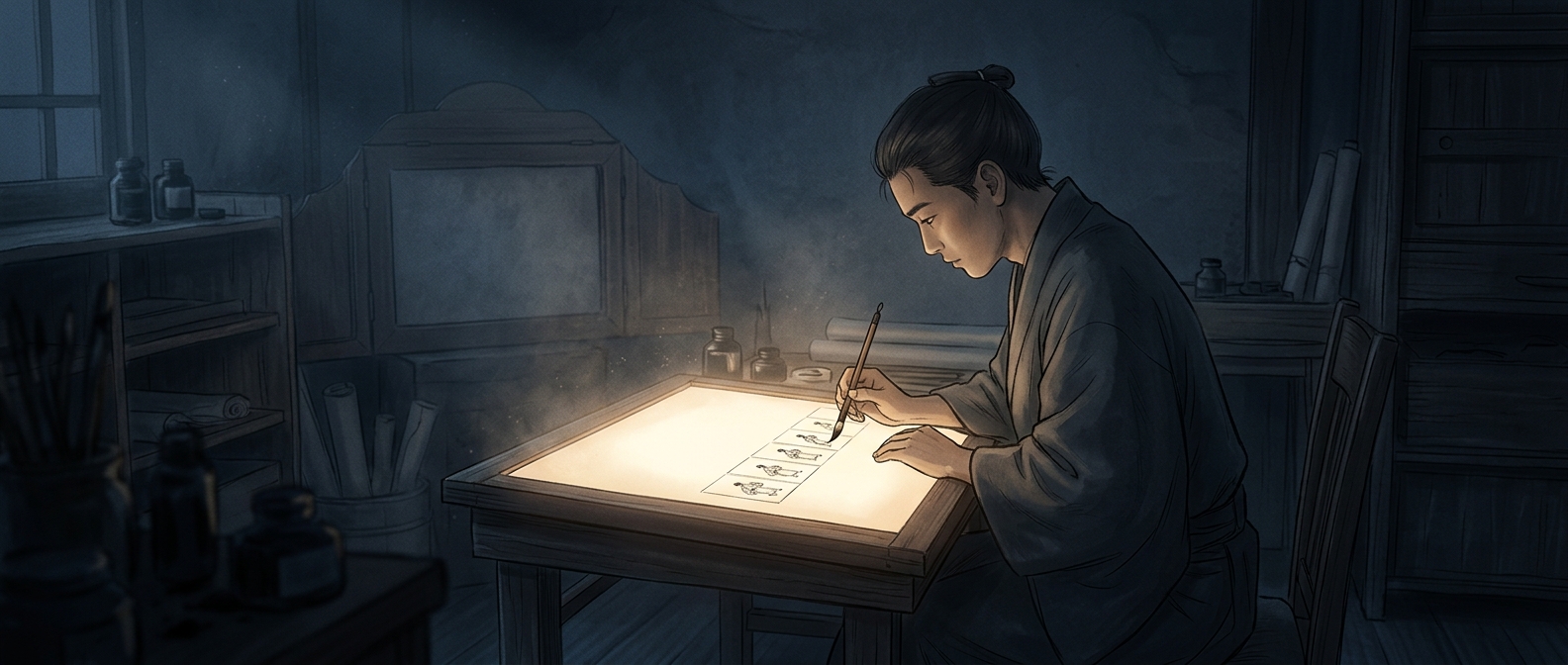
Fifty frames turn a still drawing into a tiny performance
Katsudō Shashin is often described as Japan’s first animation, but its entire action fits into a few seconds. The surviving strip contains 50 images: a boy writes on a board, then turns toward the viewer and bows. Projected in sequence, those separate pictures create the impression of continuous movement.
At a typical silent-film projection speed of about 16 frames per second, 50 frames take just over three seconds to pass the projector. The exact running time depends on how quickly the images are shown, but the calculation explains why this animation is so brief.
The trick is in the gaps
Each frame records the action at a slightly different moment. When the images flash past in order, the eye blends them into motion rather than registering a stack of still pictures. The same basic principle underlies much longer animated films; here, the whole effect is compressed into one small gesture.
That brevity also reflects the object’s form. Katsudō Shashin survives as a short strip of images, not as a feature-length film or a fully documented production. Its date and place in animation history are not certain enough to make “first” an uncontested label. Still, the strip offers a remarkably compact glimpse of animation taking shape: a boy writes, looks up, and bows before the scene is over.