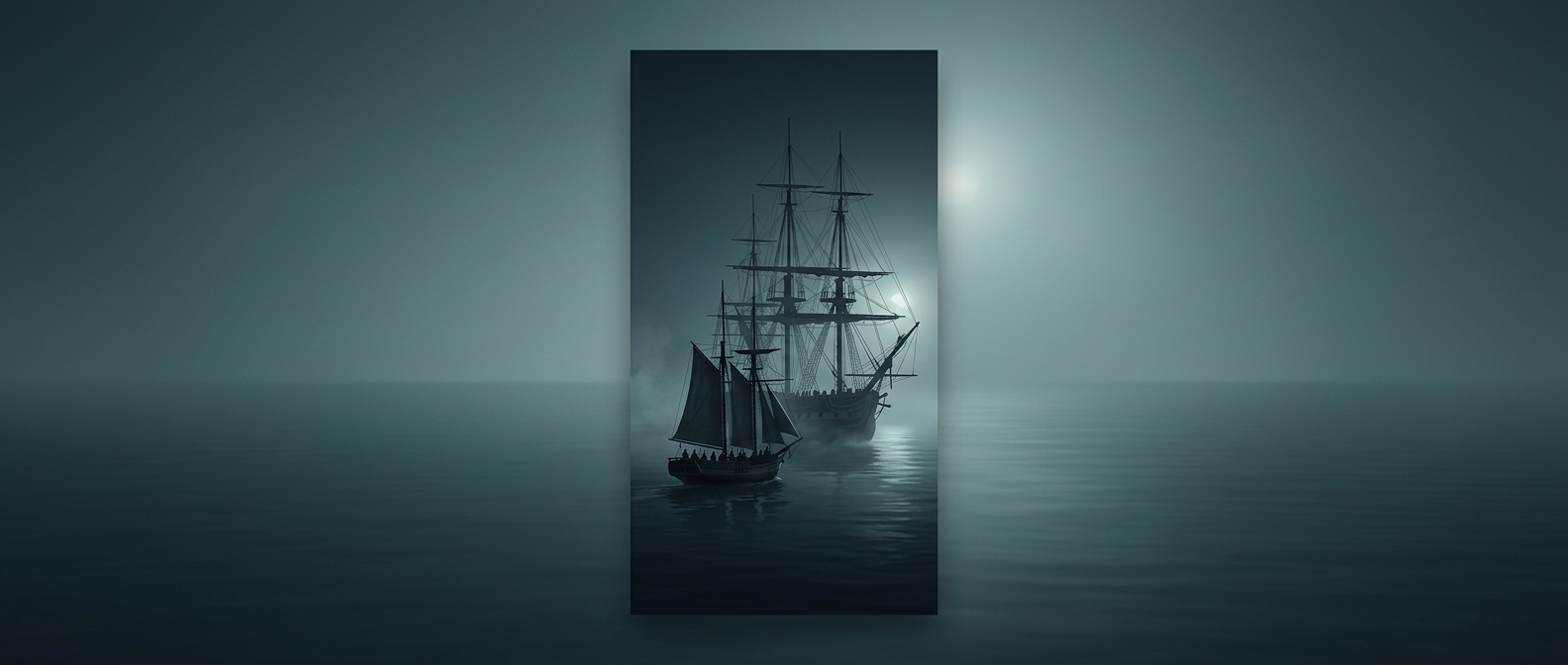
Speedy’s low profile turned a disadvantage into cover
In 1801, the British sloop Speedy, commanded by Thomas Cochrane, confronted the much larger Spanish frigate El Gamo. A frigate’s heavy guns could throw far more shot than a small sloop’s, but their height became a liability at very close range: the guns were mounted high above the water and could not be aimed steeply enough to hit Speedy’s low hull reliably. Some shots passed over its short masts instead.
Cochrane had brought the ships close enough that the difference in gunpower mattered less. That did not make the danger disappear. Speedy still faced a larger crew and a ship capable of devastating it at a more favorable distance. The close approach was a calculated way to change what the frigate’s advantage could accomplish.
A brief disguise opened the way to board
As Speedy came alongside, its sailors blackened their faces with soot and raised an American flag. The disguise helped create a moment of uncertainty, but the decisive change was physical: the ships were now within boarding distance. Instead of trying to win a prolonged exchange of cannon fire, Cochrane sent his men onto the frigate, where the fight depended on the crews meeting directly.
That shift made the larger ship’s guns largely irrelevant. Its size and armament could dominate at range; they could not easily stop attackers already climbing aboard. The frigate surrendered after the boarding action.
The capture is striking not because Speedy matched El Gamo’s firepower, but because Cochrane chose a range at which that firepower could not be used effectively. The tiny ship’s safest move was also its boldest: get close enough that the enemy’s greatest strength could no longer reach it.