Why Dallol’s crust is not one color
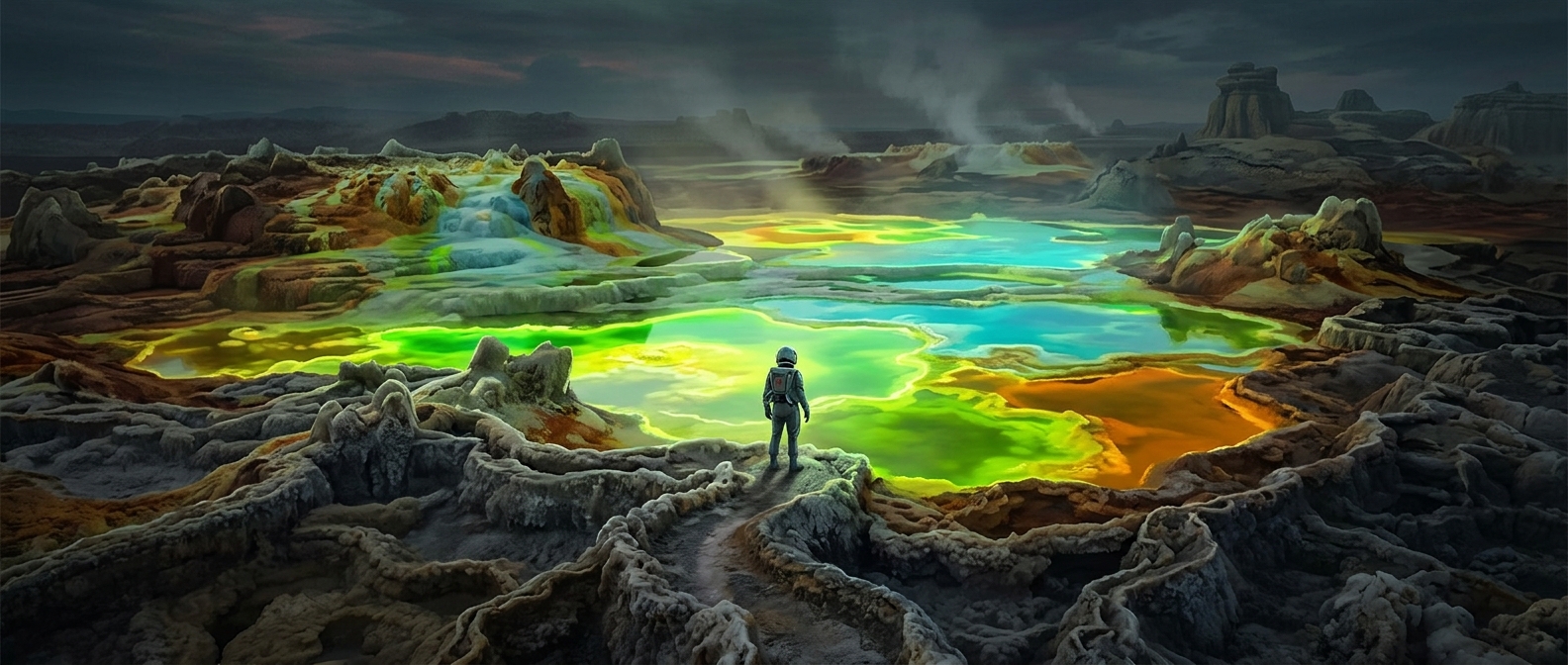
At Dallol, in Ethiopia’s Danakil Depression, water rises through a hot, mineral-rich landscape and gathers dissolved substances along the way. When that brine reaches the surface, it cools and evaporates. As water disappears, the remaining liquid becomes more concentrated until some of its dissolved material can no longer stay dissolved. It crystallizes or settles out as a deposit.
That change does not happen to every ingredient at once. Different compounds come out of the brine under different conditions, so the ground records a sequence of chemical separations rather than a single uniform layer of salt.
A landscape made by changing chemistry
The vivid patches are a mineral palette: deposits with different compositions produce different colors. As the brine’s temperature, concentration, and exposure to air shift, one mineral may form in one place while another forms nearby. Even small differences in how much water has evaporated can alter which material is left behind.
The colors therefore reveal more than the presence of minerals. They show that the water is continually changing as it moves, cools, and loses moisture. A bright surface can be the final stage of a liquid’s journey through the ground.
The striking part is the process
Dallol can look painted, but its patterns are built by ordinary physical and chemical changes operating in an extreme setting. The next pool of brine may not leave the same color as the last: its mineral mix and the conditions around it determine what separates out. The landscape is less a fixed mosaic than a visible snapshot of water becoming rock-like deposits.