Why a shell can change a bullet’s path
An armadillo’s armor is made of small bony plates, called osteoderms, set in the skin and covered by a tough outer layer. The plates overlap and move with the animal, forming a shell rather than a single solid shield.
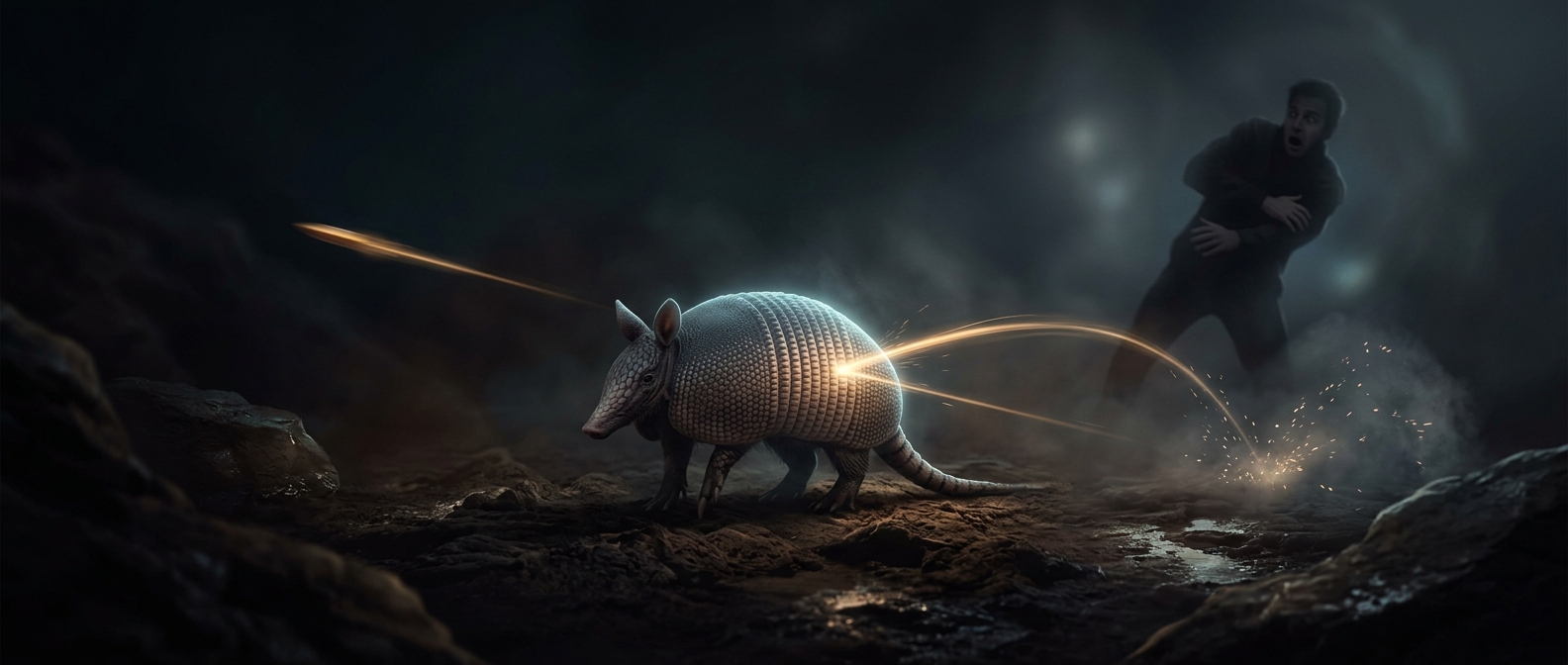
When a fast-moving bullet strikes, the outcome depends partly on the angle. A nearly head-on impact drives more of the bullet’s motion into the shell. A shallow, glancing impact can instead push the bullet sideways along the surface, sending it off on a new path. That change in direction is a ricochet—the same basic effect seen when a stone skips off water, though the materials and forces are very different.
A ricochet is not a controlled “return shot”
The shell’s curved, uneven surface can make the bullet’s path unpredictable. The bullet may glance away, deform, break apart, or penetrate; its speed and construction matter, as do the shell’s condition and the precise point of impact. Even when it deflects, it does not necessarily travel back toward where it came from. A rebound toward the shooter is only one possible geometry, not a behavior the armadillo can aim or trigger.
That distinction matters: armor can alter an impact without reliably stopping it. A ricochet may leave the animal injured, and a deflected bullet can still be dangerous in another direction. The startling “return shot” is an accidental consequence of a glancing collision, not evidence that the shell is a dependable shield.