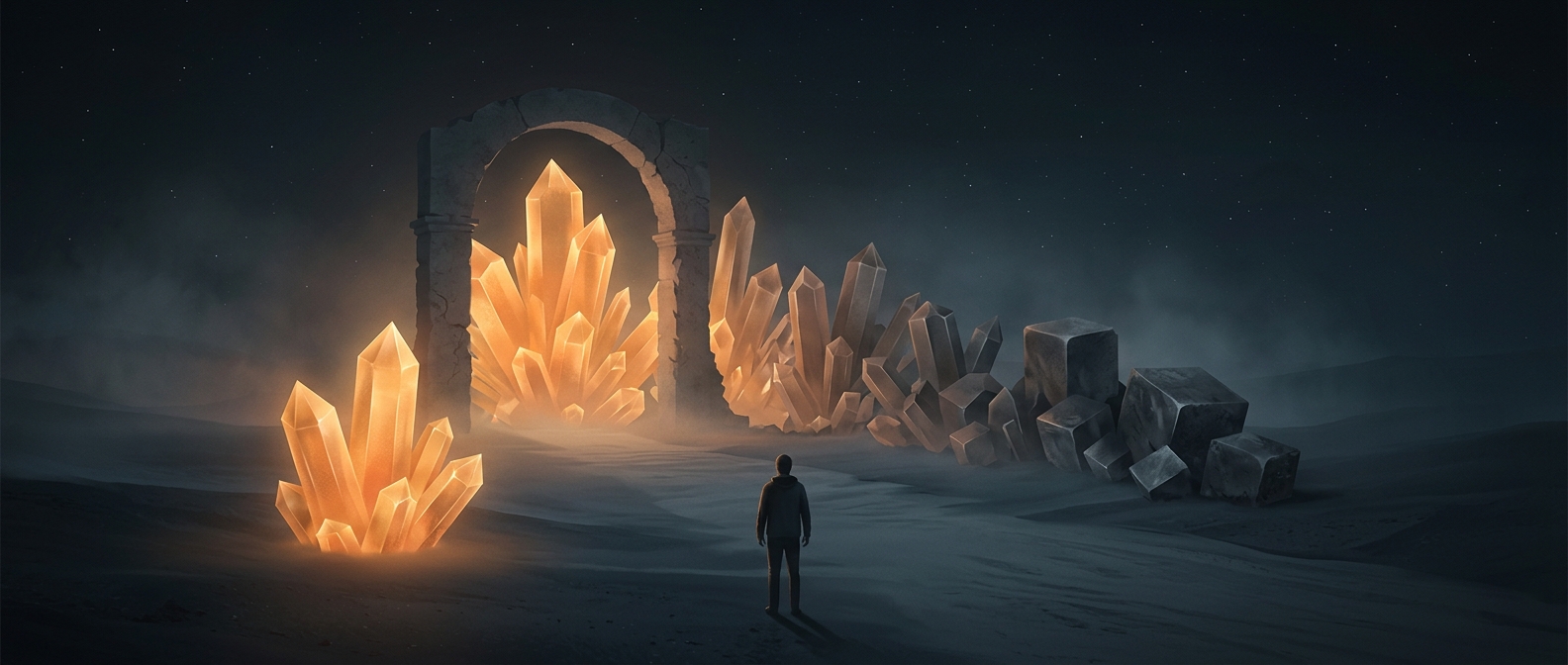
The clock is inside a grain, not the dirt
A scoop of soil is a mixture of materials, and its grains may have different histories. Radioactive dating therefore starts by choosing a particular mineral or once-living material whose history matches the event scientists want to date. The result may tell when a mineral crystallized, when an organism died, or—if the material was reset or formed during soil development—when a later change occurred. Those are not automatically the same as the age of the dirt around it.
Why the isotope balance records time
An isotope is a version of an element with a particular number of neutrons. Some isotopes are unstable: over time, each has a fixed probability of transforming into a different isotope. A half-life is the time it takes for half of a starting group of radioactive atoms to transform. It is not a countdown for an individual atom; it describes the changing proportions across a very large number of atoms.
If scientists can measure both the remaining radioactive isotope and the product of its decay, they can estimate how long that change has been under way. The method works only when they can make reasonable assumptions about the sample’s initial composition and whether atoms have entered or escaped since the clock began.
What a date can—and cannot—date
For example, a mineral grain in sediment may have formed in rock long before weathering freed it and a river carried it into a new layer. Dating the grain could reveal when it formed, not when the sediment was deposited. In some settings, scientists instead date materials that formed with the layer, or use dated layers above and below it to constrain its age.
That distinction is why a date is best read as an age for a specific material and event. The key question is not just how old the sample is, but what moment its isotope clock began recording.