A tornado’s wind is uneven, even along one street
A tornado is not a smooth cylinder of wind moving uniformly across the ground. Its air swirls and surges, and smaller, faster-moving vortices can rotate within the larger circulation. As these turbulent winds pass a house, their speed and direction can shift over short distances and brief intervals. One building may take a harder gust—or a gust from a more damaging direction—than its neighbor.
That difference matters because wind pushes on walls and can create suction that pulls upward on a roof. A structure is most likely to stay together when its parts form a continuous load path: the roof is firmly attached to the walls, and the walls are anchored to the foundation. If one connection gives way, the rest of the building can become much more vulnerable.
Debris can turn a near miss into a direct hit
A tornado also carries pieces of roofs, trees, vehicles, and other objects. These can punch through walls or windows, opening the building to the wind. Once wind enters, pressure inside can add to the forces trying to lift the roof. A nearby house might avoid a damaging impact, while another receives one in a vulnerable spot.
Construction details make a difference, too. Strong connections and protected openings can help a home resist wind and debris, though no ordinary house is guaranteed to survive a powerful tornado. The damage reflects an interaction among the storm, what it carries, and the buildings in its path—not a neat boundary between places the tornado “hit” and “missed.”
Survival is not a dependable pattern
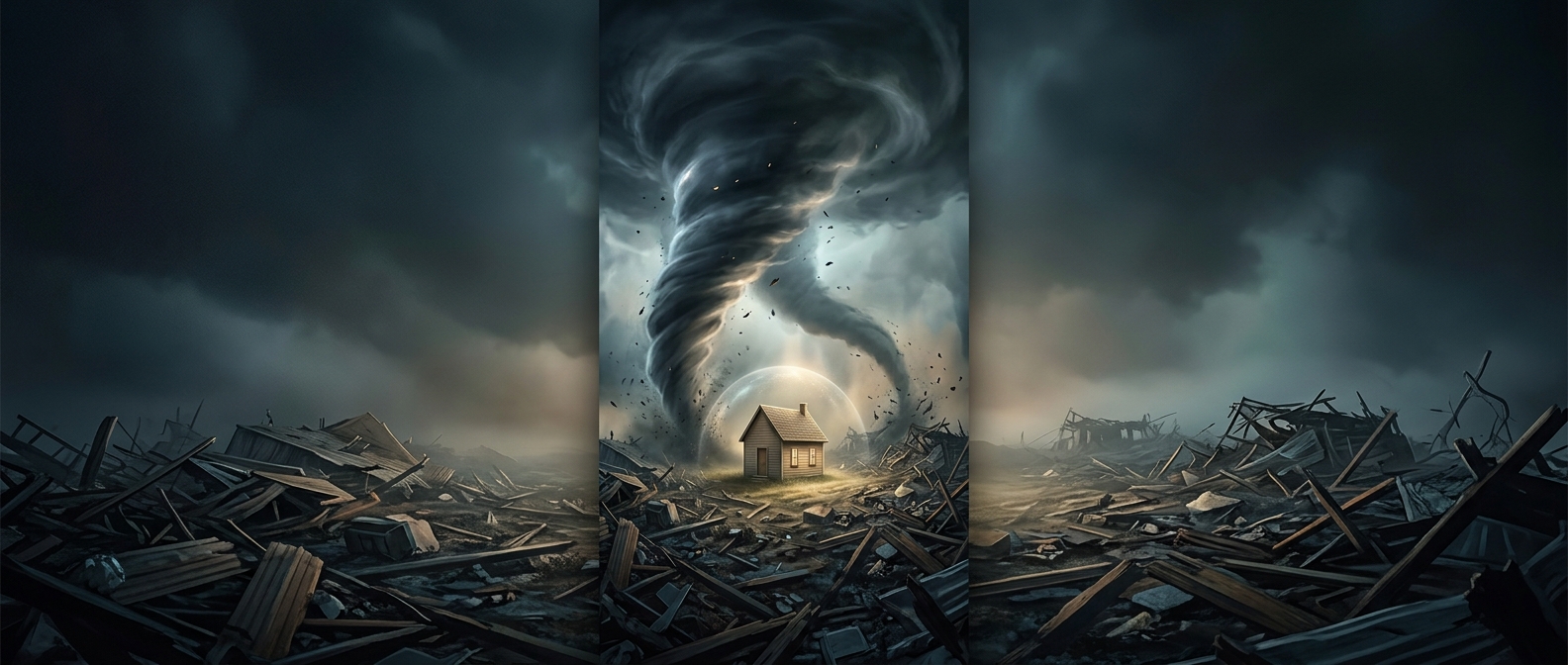
A house left standing beside wreckage may have faced a weaker gust, escaped a major debris strike, or held together because of its construction—or some combination of these. The neighboring damage cannot tell you that the surviving home was outside the tornado’s reach. It shows how sharply the forces and impacts can vary from one structure to the next.