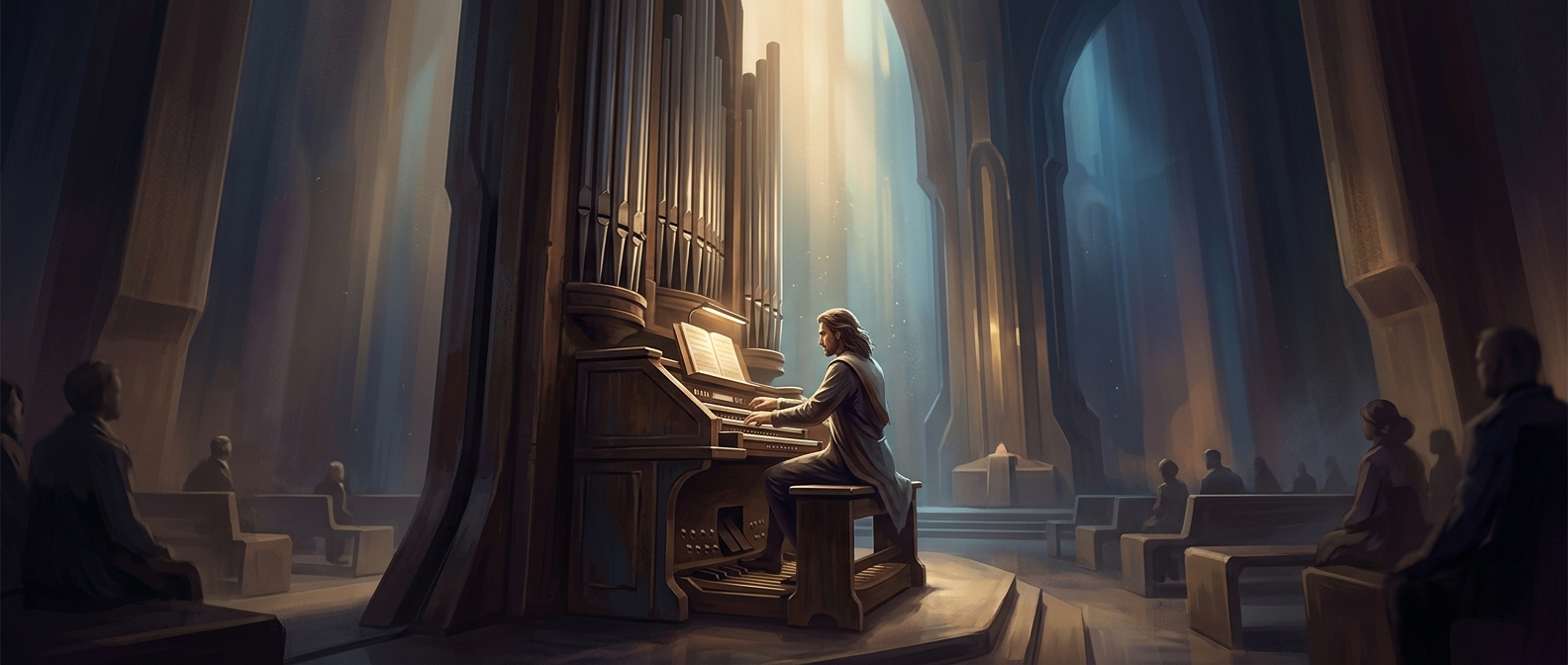
Why Cage Made “As Slow as Possible” So Slow
John Cage’s ASLSP—short for As Slow as Possible—began as an instruction, not a fixed-duration epic. Cage left performers room to decide how slowly to play it. When organizers in Halberstadt, Germany, planned an organ version, they faced a practical puzzle: an organ can sustain tones for a long time, but a performance lasting centuries would require more than simply holding down a key.
They chose a duration of 639 years, linking the project to the roughly 639-year gap between the construction of Halberstadt’s medieval organ and the planned start of the performance in 2001. The long span turns Cage’s open-ended instruction into a public commitment that outlasts its original organizers.
How a Concert Can Continue Across Generations
An organ’s pipes sound when air passes through them. In Halberstadt, the instrument is specially arranged to keep the piece going without a musician continuously playing: weights hold keys down, while the organ’s bellows supply air. The notes are changed only at intervals, so the music unfolds as a sequence of sustained tones and silences rather than a conventional stream of melody.
The slow pace makes each change an event. A new chord can draw visitors to the church, while most of the performance consists of waiting for the next one. The work is not meant to be heard in one sitting; its scale asks listeners to imagine music as something a community can maintain over time.
The Finale Is a Promise, Not a Forecast
The performance’s scheduled end in 2640 is a plan, not a guarantee that the same instrument or institution will survive unchanged. Keeping the work alive requires future caretakers to maintain the organ, preserve the project’s timing, and decide how to carry out its instructions. Its most striking effect is therefore practical as well as musical: a piece whose notes change only every few years makes the future part of the performance.