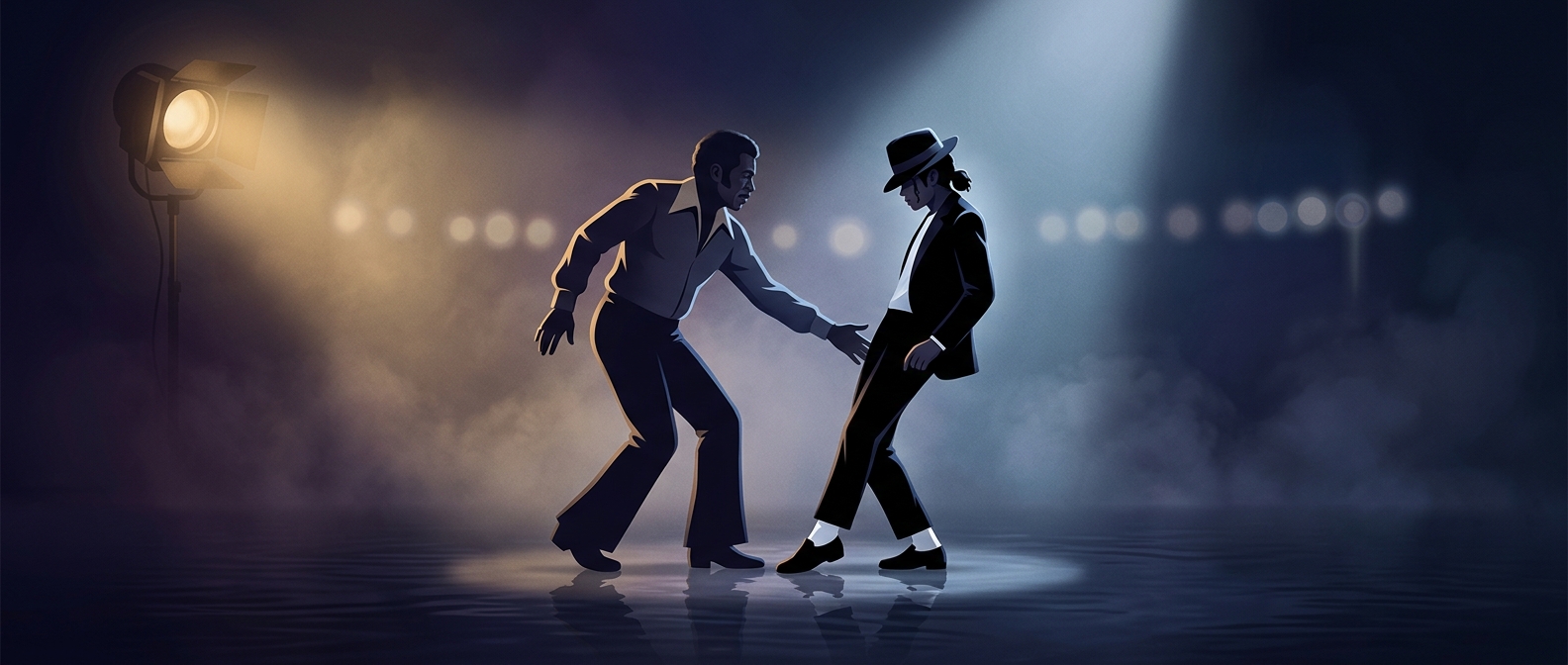
From a dancer’s lesson to a stage illusion
The moonwalk looked as if Michael Jackson were gliding forward while his feet moved backward. The trick was an existing street-dance move, often called the backslide—not a step invented for Jackson. Dancer Jeffrey Daniel, known for appearing on the television show Soul Train, taught Jackson the move in private lessons.
Learning the step was only part of the work. To make it read clearly from a distance, Jackson had to control the timing and keep his upper body unusually calm. That contrast is what sells the illusion: one foot appears to slide back as the other lifts and takes the dancer’s weight, then the feet switch roles. Done smoothly, the body seems to travel in a direction the feet contradict.
What Jackson changed
Jackson adapted the move to his own performance style rather than reproducing a lesson exactly. His precise pauses, upright posture and sharp transitions made the backward glide part of a larger piece of stage storytelling. The audience saw not just a dance step but a seemingly impossible response to the music.
When he performed it during “Billie Jean” at the 1983 Motown 25 television special, the move reached a huge audience. The broadcast did not create the backslide; it gave Jackson’s distinctive version a defining public moment. Afterward, many viewers associated the moonwalk with him, even though dancers had been doing variations of it before.
That distinction is the point of the story: a dance can have a history before it has a famous face. Jackson’s contribution was to absorb an existing technique, refine how it looked onstage and make the illusion unforgettable to millions.