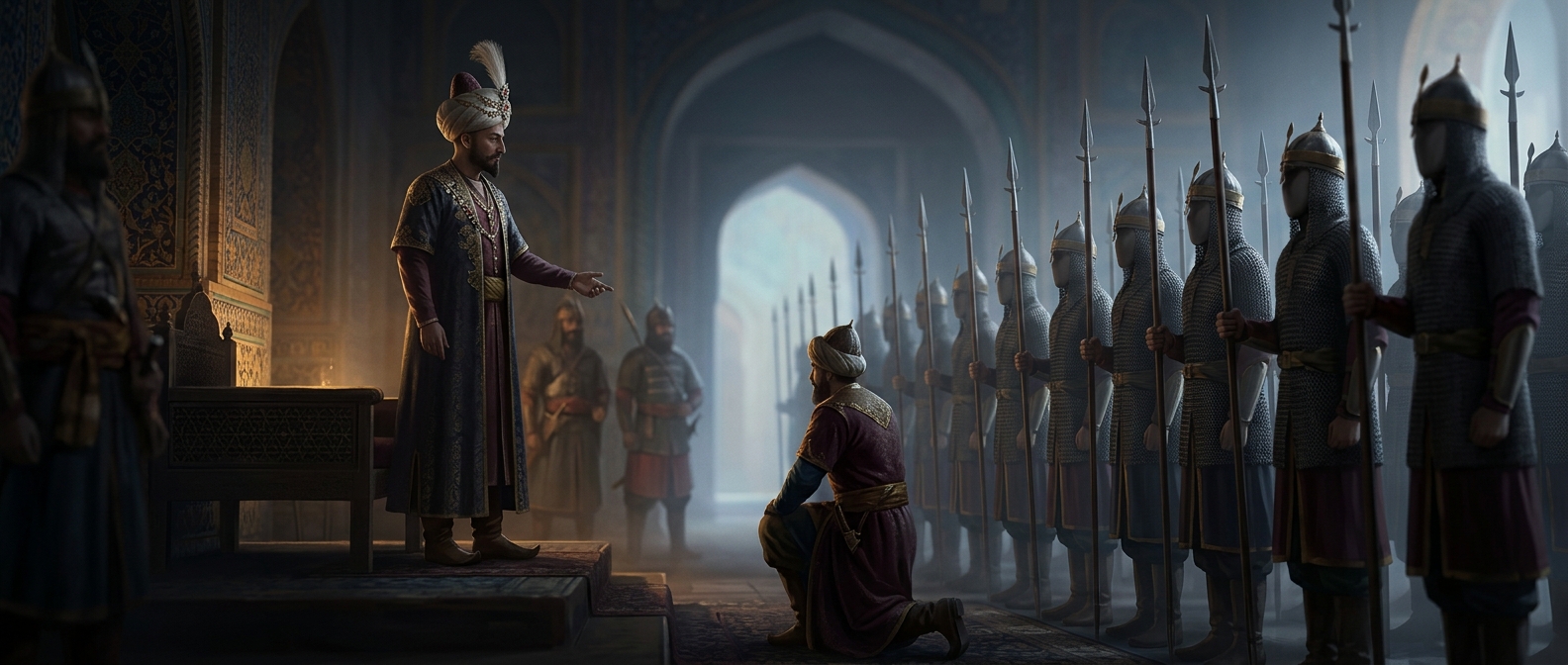
Why Shah Abbas created a counterweight to the Qizilbash
When Shah Abbas I took power in Safavid Iran, the Qizilbash—tribal military leaders whose forces had helped establish the dynasty—held considerable influence. Their loyalty mattered, but their regional bases and armed followings also made them a potential rival to the crown. Abbas’s answer was to build up a second set of servants whose careers depended more directly on the shah.
From captive boys to court officials
The shah drew many of these recruits from Christian communities in the Caucasus, especially Georgia. Boys taken in campaigns were enslaved, converted to Islam, and trained for service. Some became soldiers; others entered the administration or court. In this setting, ghulam meant a military or household servant bound to the ruler, not simply a low-ranking laborer.
Some Georgian ghulams were castrated and served as eunuchs. Eunuchs could hold positions inside the palace and household as well as in government, giving the ruler trusted intermediaries in spaces where other officials had limited access. Their status came from appointment and favor, rather than inherited tribal authority.
A new route to power—and a new balance
The ghulam system did not erase the Qizilbash or make every recruit equally loyal. It gave Abbas another pool of soldiers and officials to promote, reducing his dependence on any single tribal elite. A man who owed his position to the shah could help carry orders, manage offices, and reinforce royal authority across the empire.
The change was both military and administrative: power increasingly ran through officials whose advancement came from the ruler. For Georgian recruits, service could bring striking influence despite their origins in captivity; for the shah, their rise provided a way to govern through people whose fortunes were tied to his court.