Why tiny crystals can make a room seem to spin
The inner ear contains two systems that help the brain track balance. The semicircular canals detect rotation: when the head turns, fluid inside a canal shifts and bends sensory cells that report the movement. Nearby, the utricle helps sense gravity and straight-line motion. It is lined with microscopic calcium-carbonate crystals, called otoconia, that add weight to its sensors.
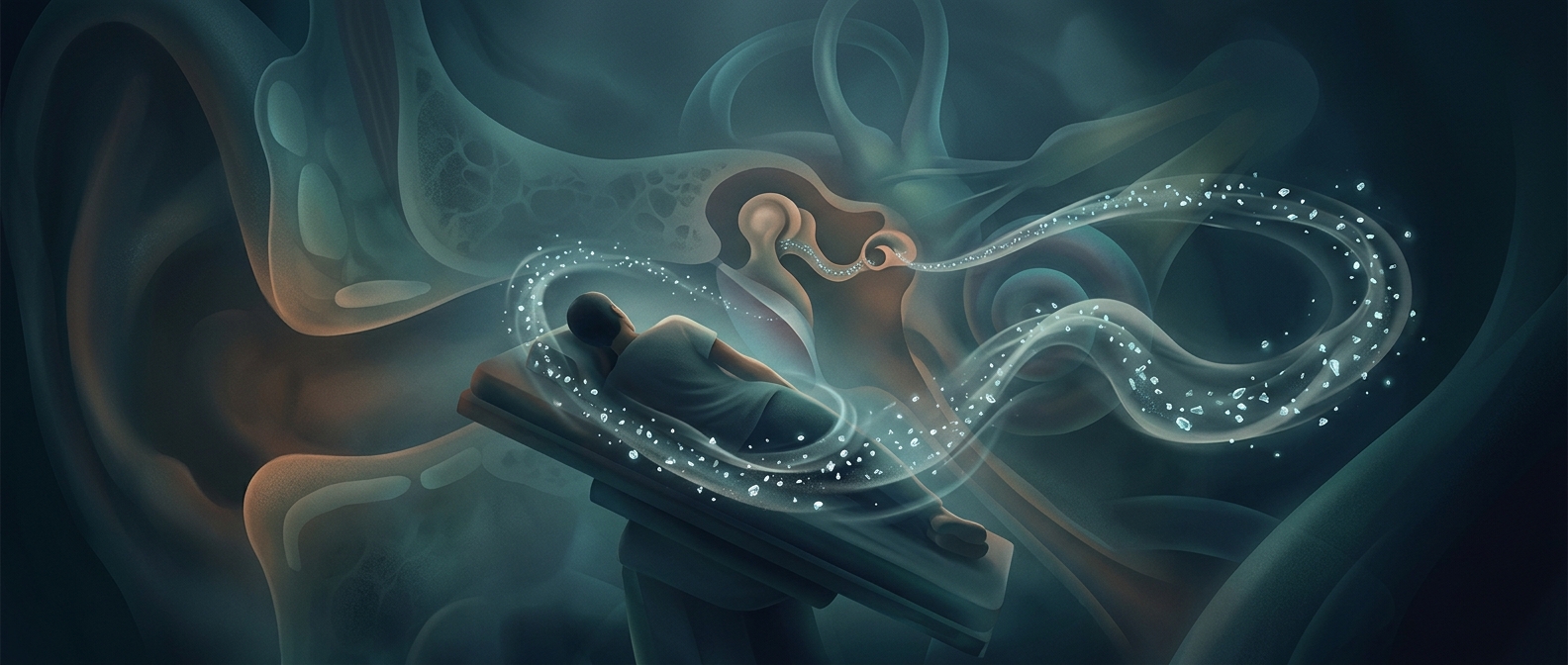
If some crystals loosen and enter a semicircular canal, a change in head position can make them move through the canal’s fluid. That movement bends the sensory cells at the wrong time, sending the brain a signal that the head is still turning. The mismatch between that signal and what the eyes and body report can produce brief, intense spinning—often when rolling over in bed, looking up, or bending down. This condition is called benign paroxysmal positional vertigo, or BPPV.
How the Epley maneuver uses gravity
The Epley maneuver is a sequence of carefully chosen head and body positions. The clinician first turns the head toward the affected side, then guides the person through a series of positions that rotate the canal’s opening downward. The aim is not to dissolve the crystals or stop the ear’s sensors; it is to move the loose particles out of the sensitive canal.
Each position is held long enough for gravity to draw the particles along the canal. The sequence eventually guides them back into the utricle, where they are less likely to trigger the same false rotation signal. The pauses matter: moving too quickly could stir the particles rather than let them settle in the intended direction.
Why the sequence must match the problem
The maneuver is most often used when the loose particles are in the posterior semicircular canal, but vertigo can have other causes, and particles can affect different canals. A clinician can use the pattern of symptoms and eye movements during positional testing to identify the likely side and canal, then select an appropriate maneuver. When the route is right, a brief series of ordinary-looking head turns can restore a more reliable signal from the inner ear—without surgery or medication.