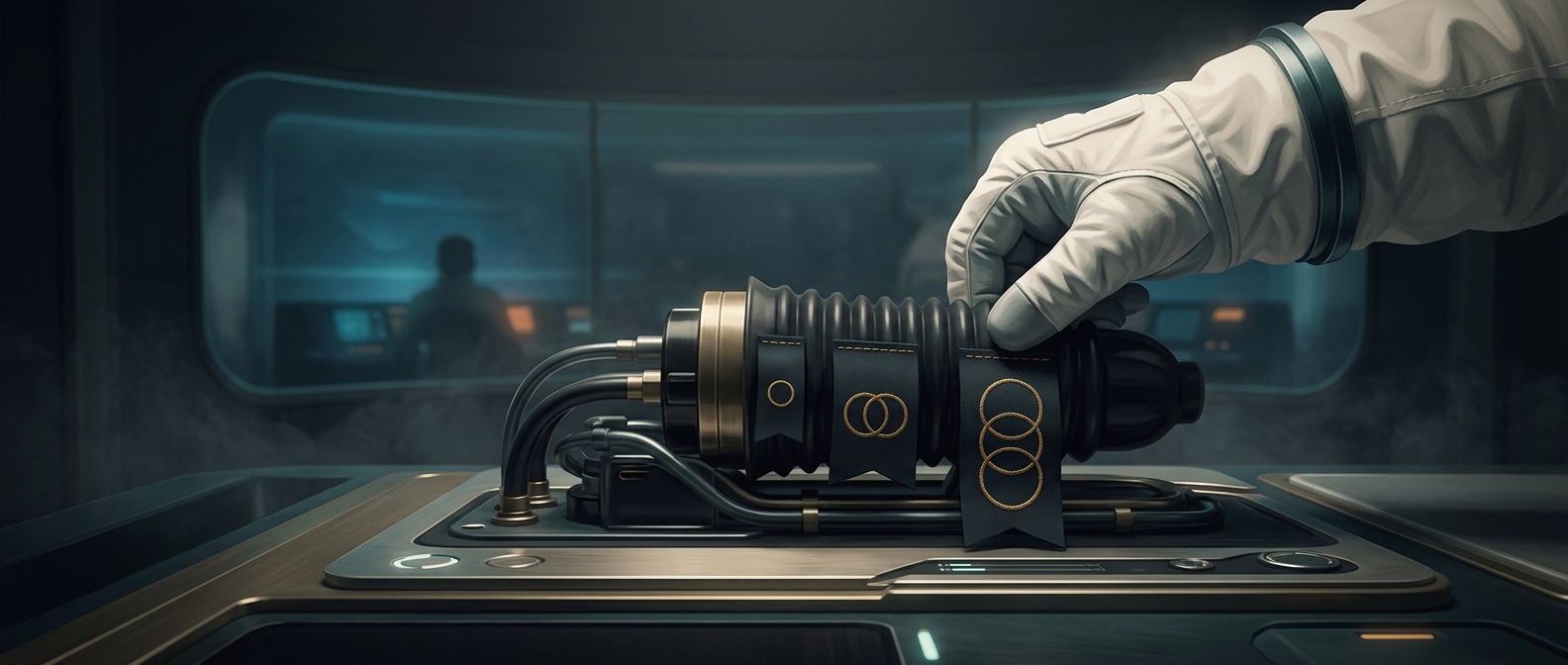
Why a Spaceflight Urine Collector Had to Fit—and Sound Right
During spaceflight, a conventional toilet is not an option: without gravity, liquid does not simply flow downward into a bowl. Early spacecraft therefore used a hose-and-funnel arrangement to collect urine. For male astronauts, the funnel had to seal closely against the body so liquid would enter the hose instead of escaping into the cabin.
That made sizing more than a matter of comfort. A collector that was too large could leave gaps, turning a basic bodily function into a cleanup problem in a place where stray droplets could drift into equipment. A smaller, snugger fit worked better, but astronauts still had to choose and use the equipment.
The Label Was Part of the Design
Astronaut Mike Mullane later recounted that men sometimes chose oversized collectors, and leaks followed. The apparent mismatch was not solved by reshaping the hardware alone. The size labels themselves could influence the choice: a label that sounded small might discourage someone from selecting the fit that actually worked.
The reported fix was to give even the smallest size a more flattering name. That did not alter the collector’s dimensions or its need for a close seal. It changed how the choice felt to the person making it.
Engineering Includes the User
The episode shows why equipment design does not end when a device works in a test. A system can depend on a precise fit and still fail if people avoid the right option. In this case, a tactful label helped align the astronaut’s choice with the equipment’s practical requirement—because in microgravity, a poor fit could leave nowhere for a leak to go but into the cabin.