Why Pluto and Neptune’s Paths Don’t Lead to a Collision
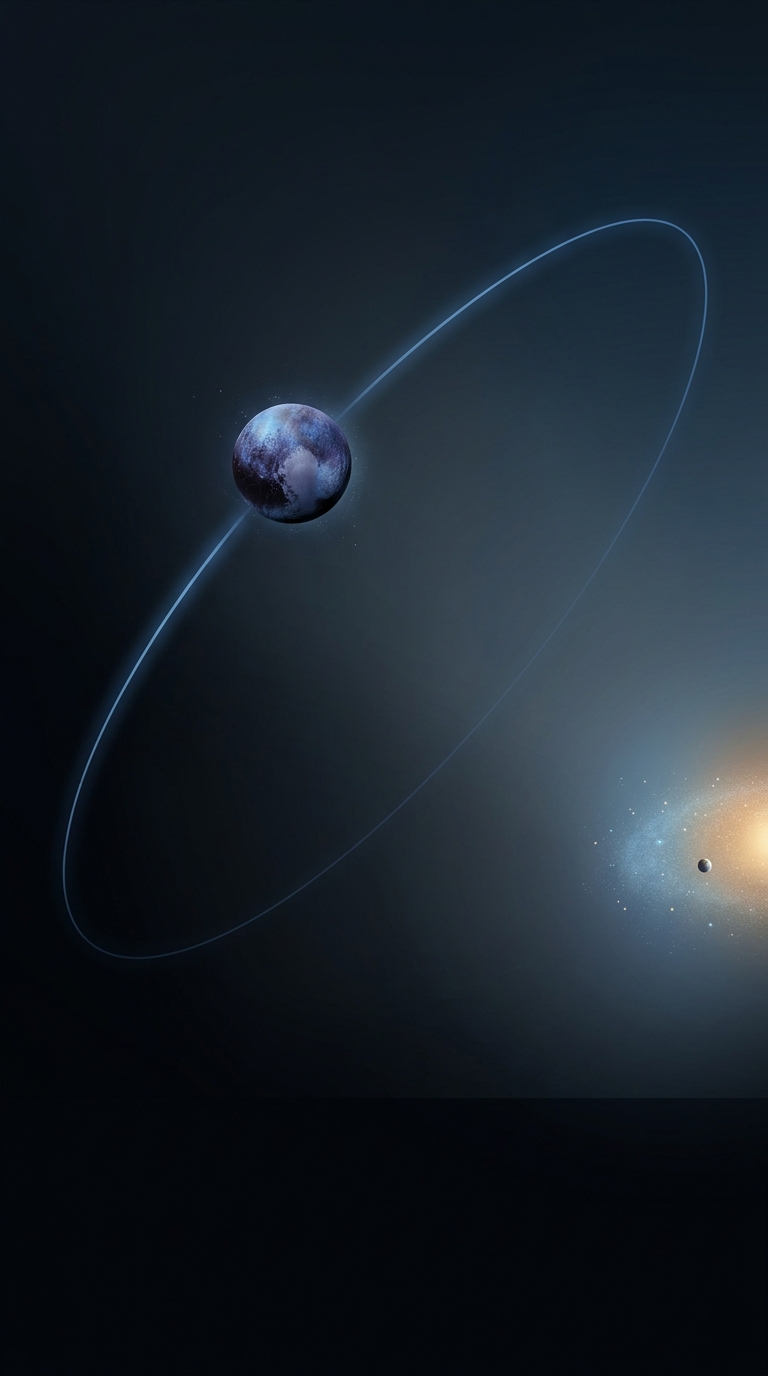
Pluto’s orbit crosses the distance range traveled by Neptune, but that does not mean the two worlds occupy the same place at the same time. Their motion is synchronized by an orbital resonance: for every three times Neptune circles the Sun, Pluto completes two orbits.
That repeating rhythm keeps their closest approaches safely separated. When Pluto passes through the part of its orbit that lies inside Neptune’s orbital distance, Neptune is elsewhere. The two planets’ orbital planes are also tilted relative to each other, so their paths do not lie on the same flat track.
A Long Orbit, a Short Window
Pluto’s orbit is noticeably elongated, not nearly circular like the paths of the major planets. As it moves around the Sun, its distance changes substantially; its closest point to the Sun falls within Neptune’s orbital distance. But a crossing in distance is not a crossing in space: the resonance controls the timing, while the tilt separates the paths vertically.
This arrangement is not a one-time near miss. The same orbital relationship repeats, making the geometry stable over long stretches of time. Pluto can pass inside Neptune’s orbital boundary without passing close to Neptune itself.
What “First Revolution” Means
Since its discovery in 1930, Pluto has been observed through only part of one full circuit. Its first complete post-discovery orbit will end in 2178—a useful reminder that, for distant worlds, a human lifetime can capture only a slice of the celestial rhythm. Neptune’s repeating steps help keep that unfinished lap from becoming a dangerous encounter.