Why freight locomotives use electric drive
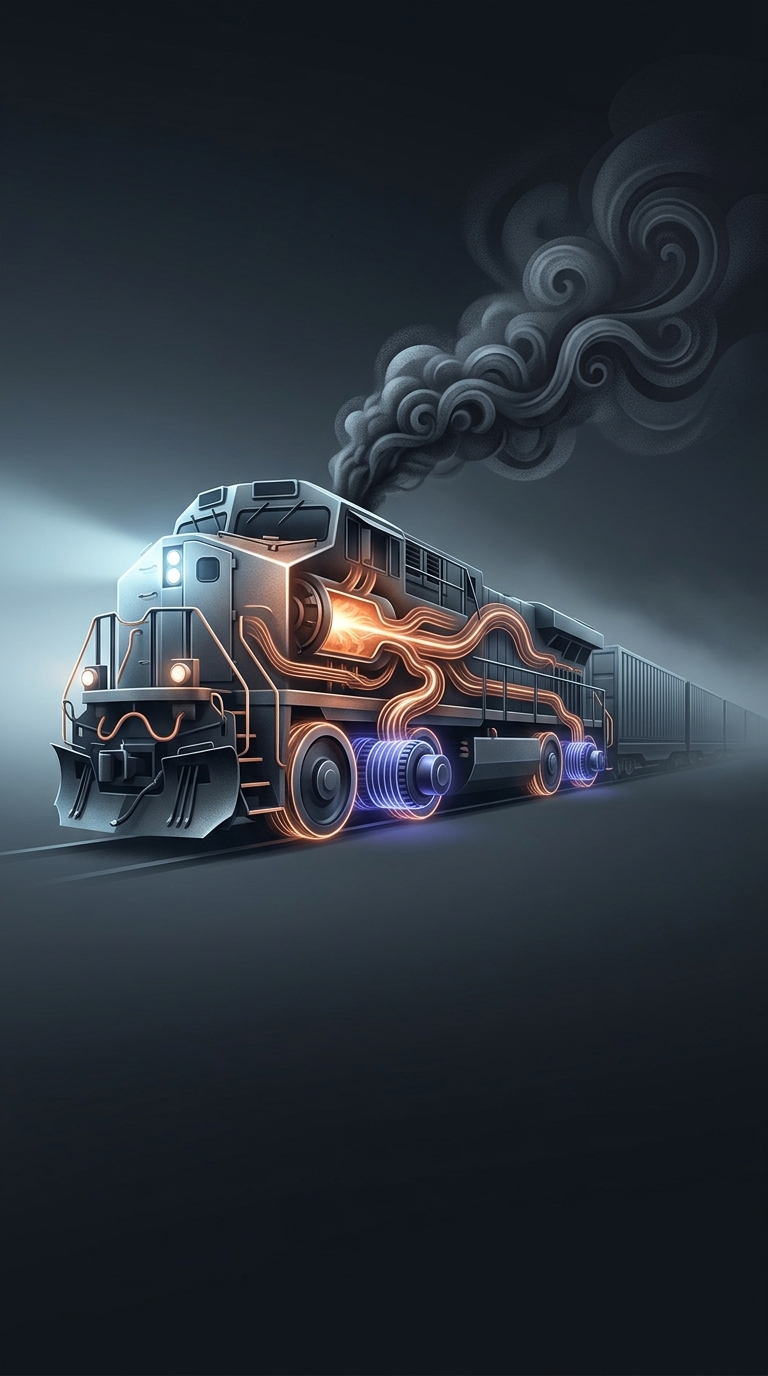
A freight locomotive’s diesel engine does not turn its wheels through a gearbox. It spins a generator, which supplies electricity to traction motors—electric motors mounted near the axles. Those motors turn the wheels and provide the force that moves the train.
The arrangement is called diesel-electric drive. The diesel engine is still the source of the energy; electricity is the means of transmitting that power to the wheels. This lets the locomotive use electric motors without needing an overhead wire or a battery large enough for a long freight journey.
The advantage at a standstill
A freight train needs strong pulling force before it is moving. Electric motors can produce high torque—the turning force at the axle—from very low speeds. That makes them well suited to starting a heavy train and keeping it moving slowly, tasks that would be difficult to handle with a conventional mechanical transmission connecting one engine to many driven wheels.
Instead of routing power through a complicated set of gears and shafts, the locomotive sends electrical power to motors at the axles. The motors can deliver that power where it is needed while the locomotive’s diesel engine runs in a useful operating range. The result is a practical way to combine a self-contained power source with electric traction.
A power plant that travels with the train
The design does not make a freight locomotive emission-free: it still burns diesel, and its exhaust and engine noise travel with it. Nor does it mean the diesel engine itself supplies the wheels with electricity directly; the generator and traction motors form the link between engine and rail.
The key tradeoff is flexibility. Electric traction gives a locomotive the pulling characteristics needed for heavy loads, while onboard diesel frees it from a continuous external power supply. The train carries its own power plant—and uses electric motors to put that power to work at the rails.