Why a wakeful night can blur in memory
Time is not stored in the brain like a running stopwatch. When people later estimate how long something lasted, they often use remembered changes and events as landmarks. A busy hour may seem long because it contains many distinct moments; a quiet stretch can feel brief—or, if it was uncomfortable, seem to have dragged on.
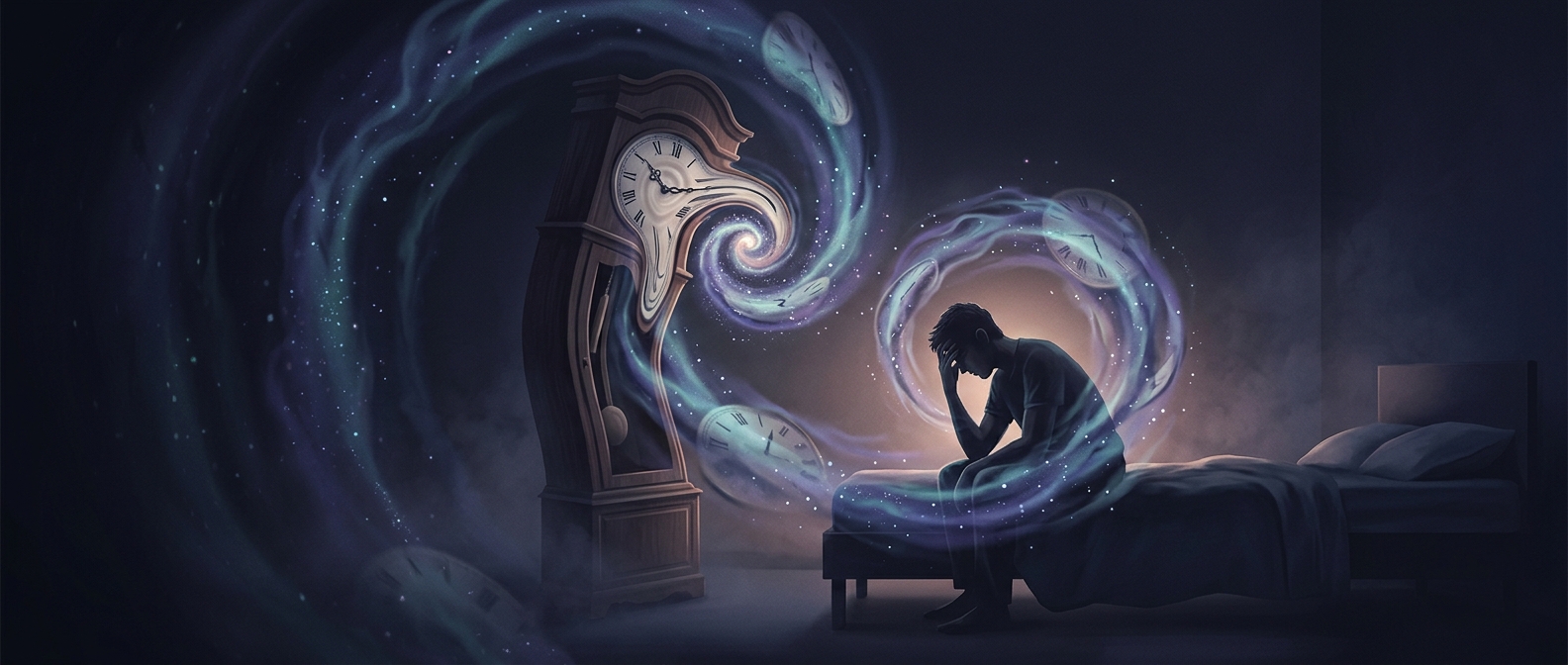
During a restless night, those landmarks may be hard to form. Wakefulness can come in repeated, similar stretches, with little to distinguish one from the next. Later, the mind has less of a sequence to reconstruct and may treat an uncertain span as much longer than it was.
Watching the clock changes the experience
There is a difference between judging time while it passes and estimating it afterward. If someone is awake and repeatedly checking the clock, attention is fixed on the passing minutes, which can make the wait feel especially slow. In the morning, however, the estimate also depends on what can be remembered from the night. Those two impressions need not match.
That is why a person may feel certain they were awake for hours without having a clear memory of a continuous stretch of wakefulness. The feeling is real, but it is not a precise record of elapsed time. A night with few memorable boundaries can be difficult to measure from the inside—and even harder to reconstruct afterward.