The Sun’s energy takes a winding route outward
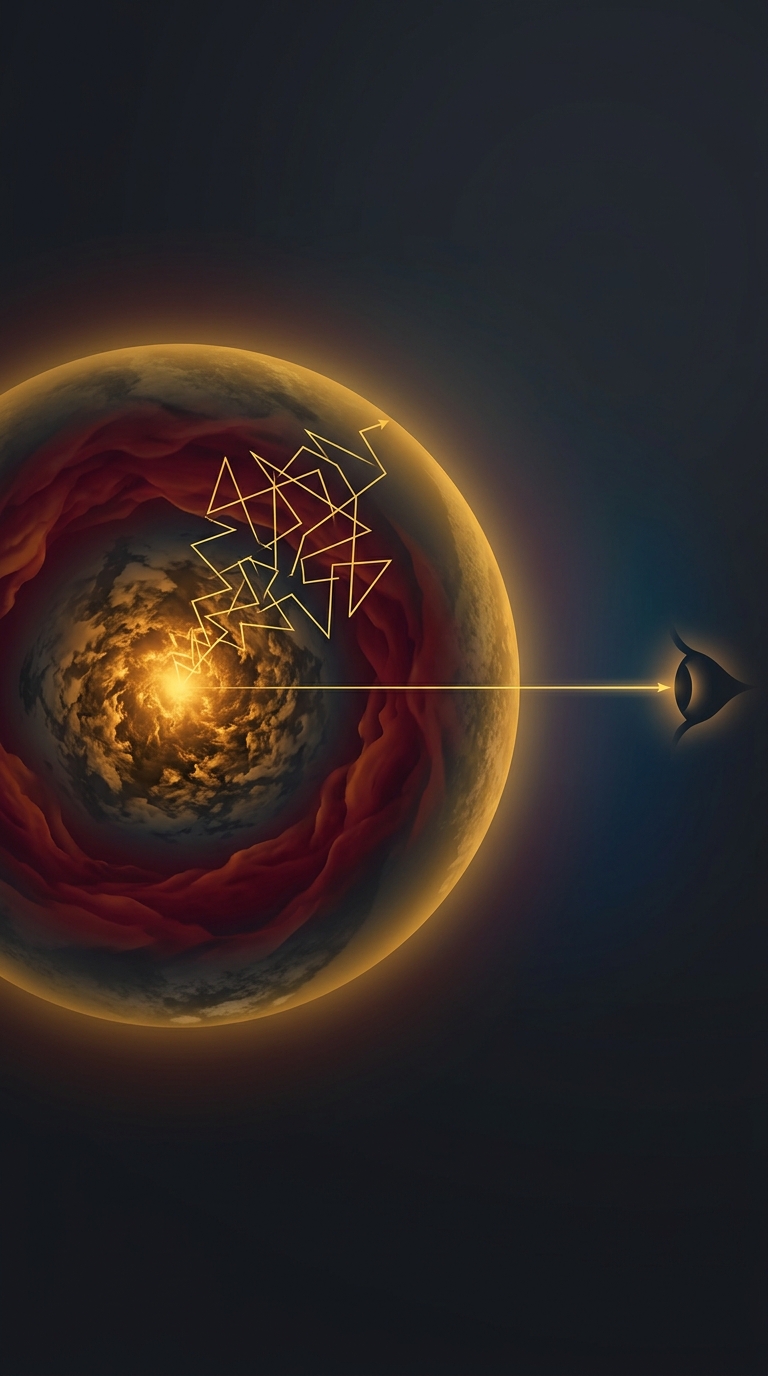
A photon is a particle of light, but deep inside the Sun it rarely keeps going as the same photon for long. It is absorbed by matter—often by an atom or ion—and its energy is later emitted again. The new photon can head in an entirely different direction. Repeating this process makes the energy’s outward progress resemble a random walk rather than a straight journey.
That distinction matters: the long delay is not a single ray slowly crossing the Sun. It is the net result of countless short steps, many of them sideways or back toward the center. In the dense interior, matter is packed closely enough that photons are repeatedly intercepted.
From trapped radiation to escaping sunlight
Farther out, the Sun’s structure changes how energy moves. In the radiative zone, radiation carries energy through repeated absorption and emission. In the outer convection zone, rising and sinking gas helps transport it: hot material moves upward, cools, and sinks again. Near the visible surface, the gas becomes transparent enough for light to escape into space.
By then, the energy has been transformed and redistributed many times; the photons arriving at Earth are not the original particles produced in the core. Once light leaves the surface, however, it travels through the near-vacuum of space without the same constant interruptions. That is why the trip from the Sun’s surface to Earth takes only about eight minutes, even though getting the energy to that surface can take vastly longer. The contrast is between a crowded interior where light is continually redirected and open space where it can finally fly freely.