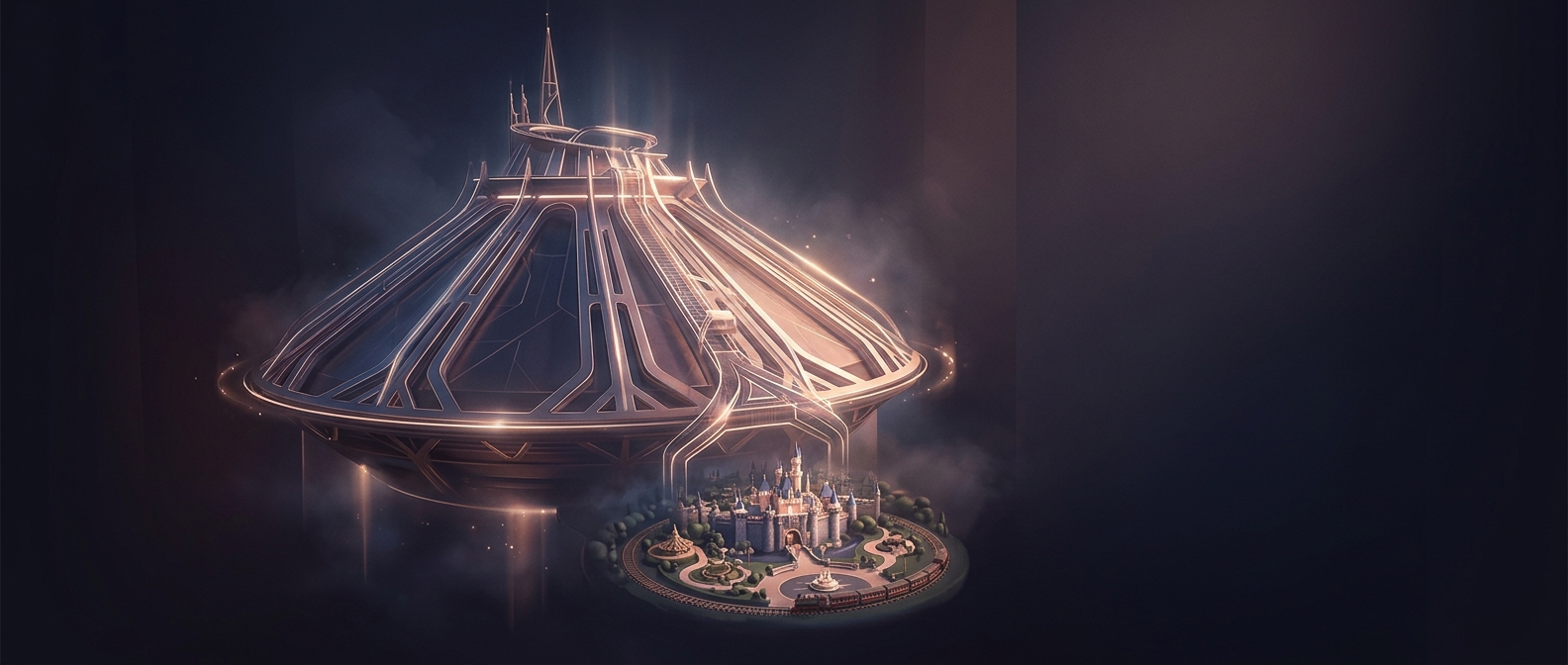
Why Space Mountain cost more than Disneyland
When Disneyland opened in 1955, its entire construction budget was about $17 million. Roughly two decades later, building Disneyland’s Space Mountain cost about $20 million. The price reflected a very different kind of project: not just a roller coaster, but a large indoor environment designed to make a fast ride feel like a journey through outer space.
The building was part of the ride
A conventional outdoor coaster can rely on the landscape—and the track itself—to supply much of the spectacle. Space Mountain had to create that spectacle inside a covered structure. Its track twists through darkness, while carefully placed lights and sound give riders brief impressions of stars and motion. With little view of the rails ahead, riders cannot easily anticipate each turn, making the same physical movement feel more surprising.
That effect depended on more than a dark room. The building had to contain the track and the supporting systems, while the ride’s layout, lighting and audio worked together as a single attraction. Visitors encountered the story before boarding, too: the themed approach and station helped frame the trip as a space voyage rather than a ride hidden in a warehouse.
A sign of how parks were changing
Disneyland’s original budget bought an entire park. Space Mountain’s larger price tag went into one elaborate attraction, built for an established park where a new experience had to stand out among existing ones. The comparison captures a shift in what a major ride could be: the coaster’s engineering mattered, but so did the building and the illusion surrounding it.
The surprising part is that much of the costly machinery was meant to disappear from view. In Space Mountain, the darkness that concealed the track was also what made the ride feel vast.