How Tinikling Turns Bamboo into a Moving Path
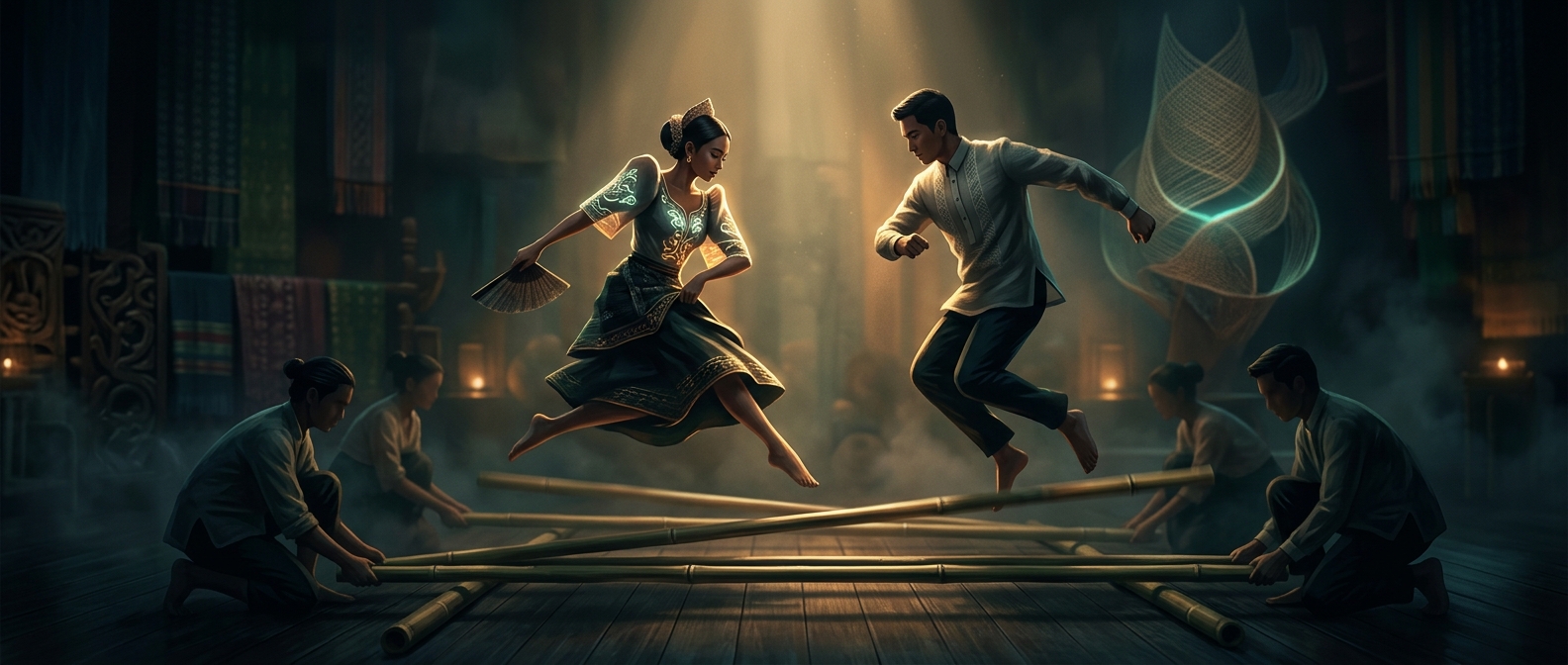
In tinikling, two people sit or kneel at one end of long bamboo poles and clap them together, then against the ground, in a repeating rhythm. The poles form a temporary opening: dancers step into it, lift their feet before the bamboo closes, and move out again as the beat continues. The challenge is not simply speed. A dancer must read the rhythm, place each step precisely, and stay relaxed enough to change direction on the next beat.
That pattern gives the dance its name and its animal reference. “Tinikling” is associated with the tikling, a long-legged bird found in the Philippines. The dance evokes the bird’s quick, careful movement through its surroundings—not by copying its shape, but through nimble steps and sudden changes of direction.
A Shared Rhythm, Not a Solo Test
The poles make timing visible and audible. Their sharp claps mark the moments when the gap is open or closed, while the dancers’ steps answer that rhythm. Pole handlers and performers therefore share the work: a steady, predictable pulse gives the dancers room to move, and the dancers’ footwork turns a repeated pattern into a performance.
For audiences, the close calls are part of the appeal. A foot landing just before the poles meet makes the timing legible from across the room; a stumble would disrupt the rhythm for everyone. Tinikling’s animal-inspired agility is thus built into a practical group skill: several people must keep one beat while moving at different speeds, with the bamboo making every fraction of a second visible.