Topsy’s execution became an electrical spectacle
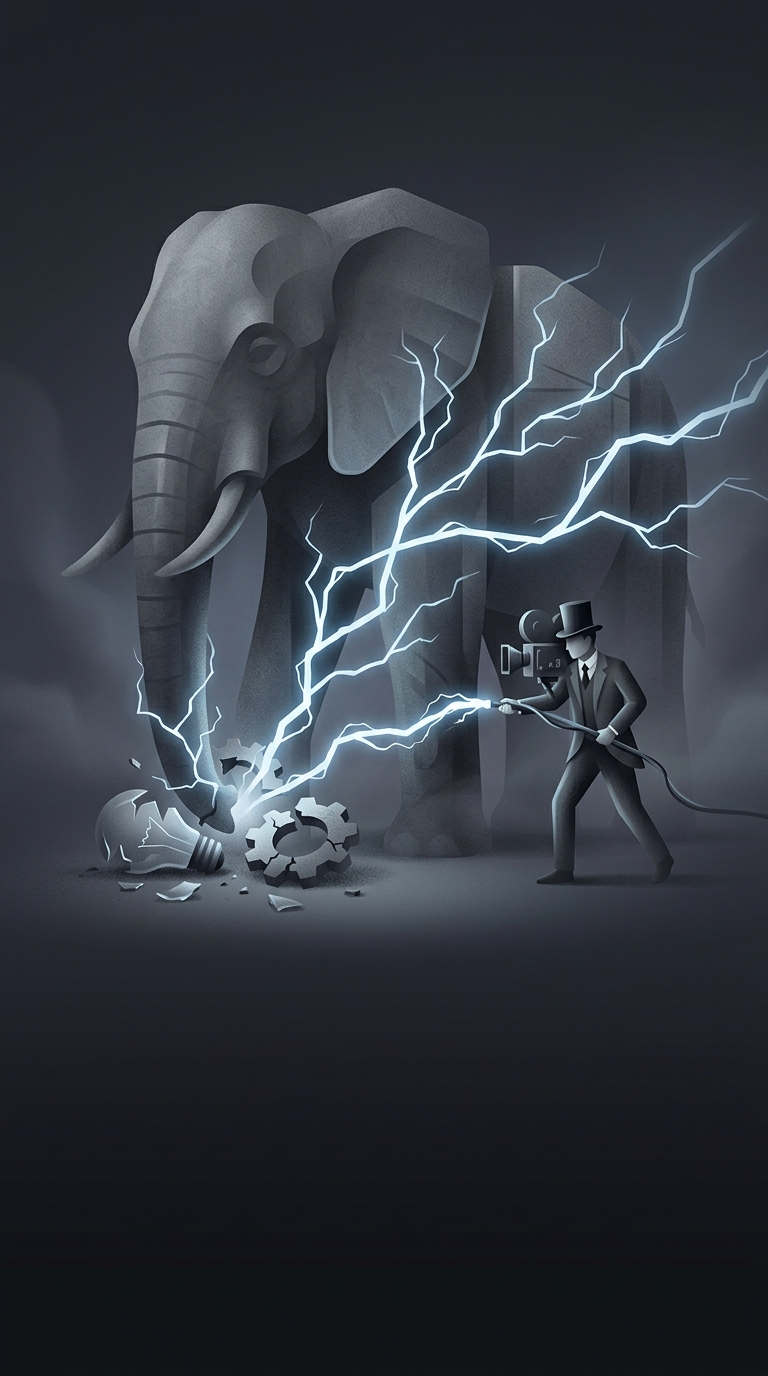
On January 4, 1903, Topsy, an elephant at Coney Island’s Luna Park, was killed in a public execution. The event was filmed and later shown as Electrocuting an Elephant. An electric current of about 6,600 volts was used, but it was only one part of the procedure: Topsy was also given cyanide-laced carrots and a rope was placed around her neck.
The killing followed a history of dangerous incidents involving the elephant and a decision by park managers to put her down. It was staged for spectators and recorded by the Edison Manufacturing Company, whose short film turned the event into a lasting piece of early cinema.
The film’s electrical backdrop
The execution took place during the long-running “war of the currents,” a public struggle over competing ways to distribute electricity. Thomas Edison championed direct current, or DC, while Nikola Tesla’s inventions helped make alternating current, or AC, a major rival. AC could be transmitted efficiently over long distances, but its use in electric-chair executions had also made it a potent symbol of danger.
That context helps explain why Topsy’s electrocution could be read as part of the argument over electricity. But the familiar claim that Edison personally arranged it simply to discredit Tesla goes further than the evidence supports. Edison was not known to have attended, and the park’s stated reason was to kill an animal considered dangerous—not to settle the competition between electrical systems.
A death repurposed as an argument
The film’s title and its images made electricity central to the spectacle, whatever the park’s immediate motive. In that way, Topsy’s death acquired a meaning beyond the execution itself: audiences could see a powerful animal brought down by current at a time when Americans were still debating which kind of electricity would shape daily life.
The revealing detail is the gap between event and interpretation. A park execution became a filmed attraction, and its electrical method made it easy to remember as a scene from the battle over AC and DC—even though that was not demonstrably why Topsy was killed.