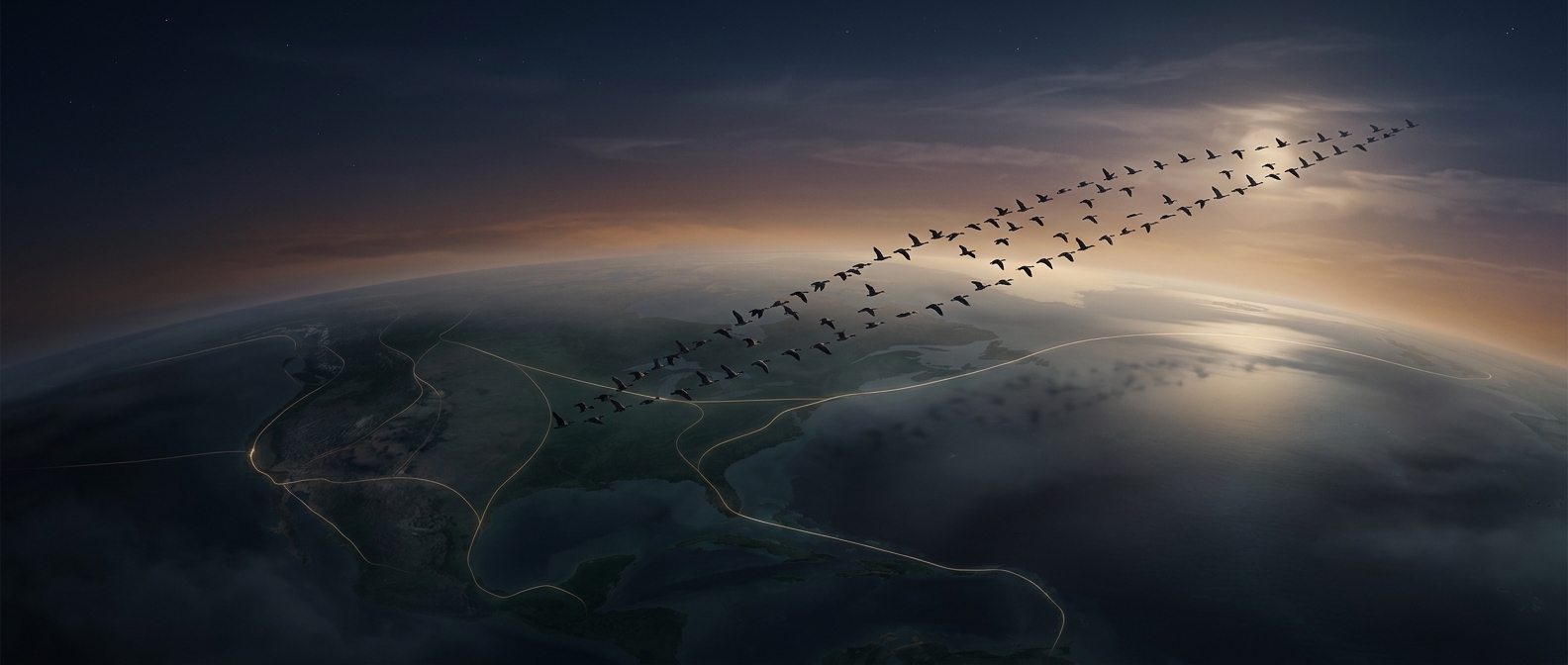
How a Goose Finds the Lift in a V
A flying bird pushes air downward with each wingbeat. Around its wings, that movement also creates swirling currents: air tends to rise just outside the wingtips, where the bird’s wing is pushing air down. A goose behind and to one side can place itself in this rising stream, gaining a small upward boost instead of having to generate all its lift by flapping alone.
That useful pocket of air is narrow and shifting. Each goose must keep the right spacing and angle behind its neighbor; fall too far back or drift into a less favorable part of the wake, and the benefit shrinks. The V is therefore not just a shape that looks orderly from the ground. It lets many birds follow one another’s moving air currents without lining up directly behind a bird, where disturbed air can make flight harder.
A Formation That Keeps Adjusting
The arrangement also depends on coordination. As a leader moves forward, the rising air along its wings gives the next bird a favorable place to fly. That bird, in turn, creates a similar opportunity for the goose behind it. If a bird tires or the group’s spacing changes, the formation can shift; the flock’s advantage comes from maintaining the pattern, not from holding a perfectly fixed V.
Taking turns at the front spreads the hardest part of the flight across the flock. The lead bird has no goose ahead to supply that lift, so it eventually yields the position to another. For a long-distance traveler, the payoff is collective: each bird can use a neighbor’s airflow, and the flock can keep moving without asking one goose to bear the full cost of leading.