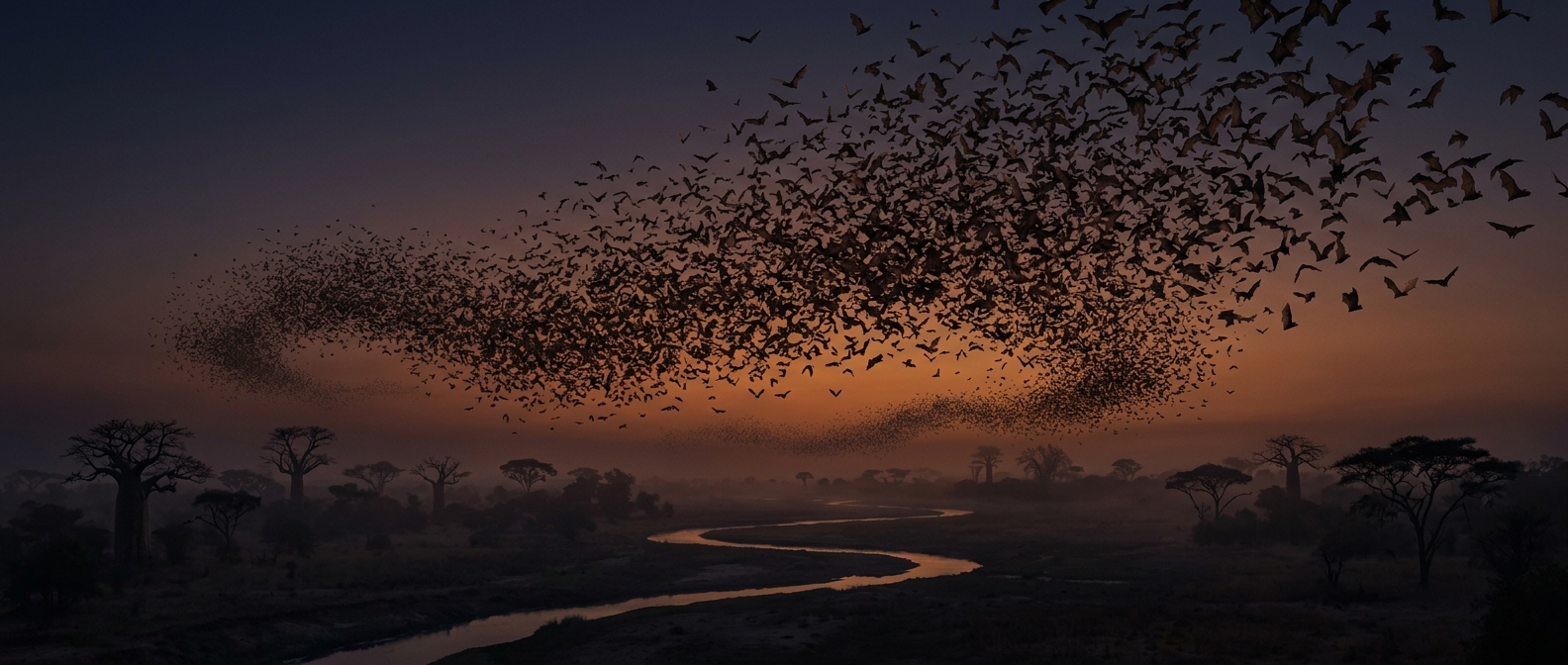
Why Zambia’s skies fill with fruit bats
Each year, straw-coloured fruit bats gather in Zambia’s Kasanka National Park as native trees produce ripe fruit. The feast is brief, so the bats do not stay year-round: they arrive when food is abundant and leave when it runs short. Their spectacular concentration is one stop in a much wider seasonal journey across central Africa.
A moving response to ripening fruit
Fruit bats depend on scattered, short-lived food supplies. Rather than remain in one place after its trees have been stripped, they travel to areas where fruit is currently available. This makes the colony a kind of living indicator of the forest’s harvest: its location shifts with the timing and distribution of ripe fruit.
That movement also helps trees. As bats feed, they carry seeds away from the parent plant, either in their mouths or through their droppings. Seeds deposited elsewhere may grow into new trees, linking the bats’ search for food to the forest’s ability to regenerate.
A crowded roost, a wide-ranging population
The bats’ daytime roost can look like a permanent settlement, but the mass gathering is temporary. When the seasonal supply fades, the animals disperse toward other feeding grounds. So the darkening sky marks not simply the presence of millions of bats, but a moment in a regional cycle: fruit ripens, bats converge, and then the moving harvest takes them on.