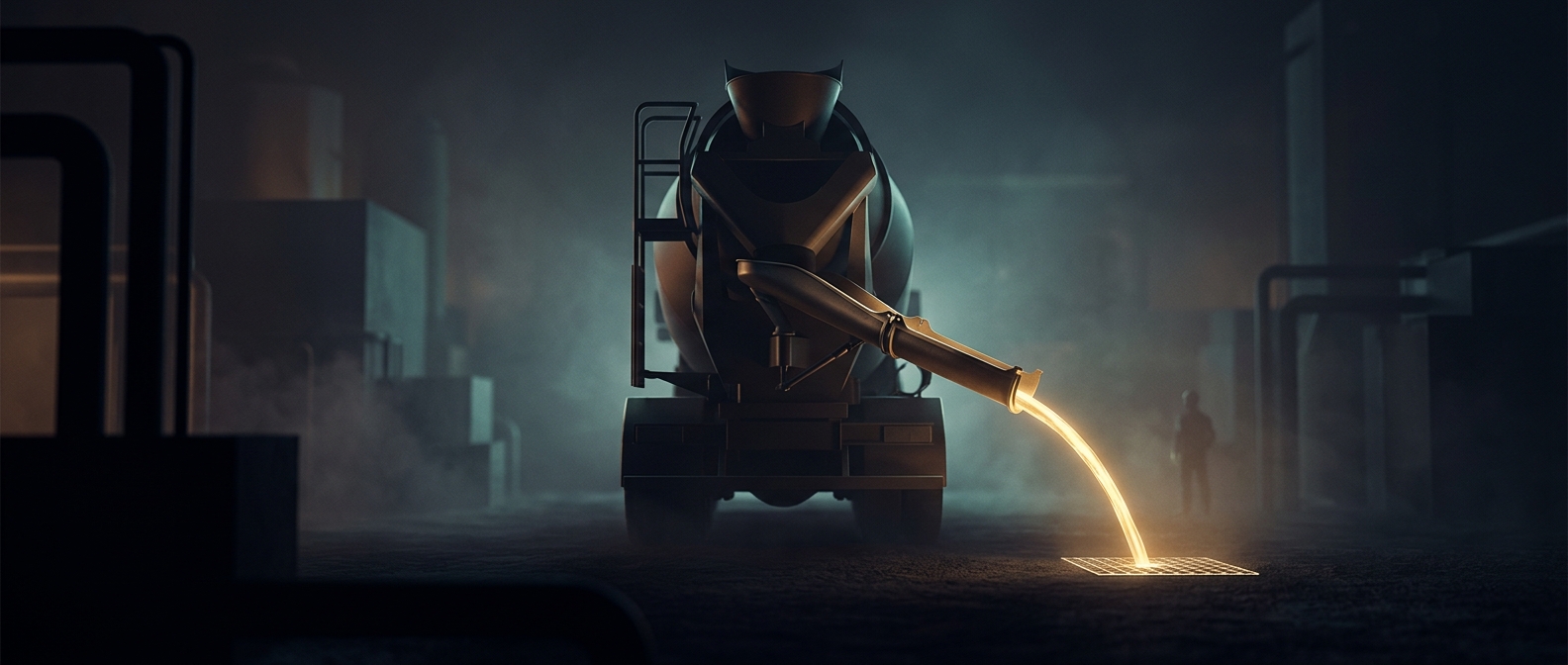
Aiming the pour without moving the truck
A mixer truck often cannot park directly beside every part of a pour. A foundation may sit behind a form, or a narrow driveway may leave little room to maneuver. The discharge chute gives the crew a way to steer the concrete from the truck’s outlet toward the placement area while the vehicle stays put.
The chute pivots at its connection to the truck, and its angle can be adjusted as the pour progresses. Its sections guide the mix downward; the driver controls how quickly concrete leaves the rotating drum, while workers reposition the chute to lay it where it is needed. That coordination matters because fresh concrete is heavy and flows under its own weight, but it is not a free-running liquid: its thick, granular mix can slow or bridge if the path is poorly arranged.
Reach has limits
A chute is useful only within its reach and at a workable slope. If the pour is too far away, too high, or blocked by obstacles, crews may need another method, such as a concrete pump. Aiming the discharge close to its final location also reduces the amount of heavy material workers must rake or shovel across forms after it lands.
The adjustment is a small piece of placement engineering: the truck supplies the mix, gravity carries it, and the crew continually changes the route as the receiving area fills. Once the pour is done, the chute must be cleaned before leftover concrete hardens into a load-bearing obstruction.