A mirror reverses depth, not left and right
A flat mirror reflects light so that the angle it arrives at equals the angle it leaves. Your eyes trace the reflected rays backward, making the light seem to come from a point behind the glass. The result is a virtual image: it looks like a person standing on the other side, but no light actually comes from there.
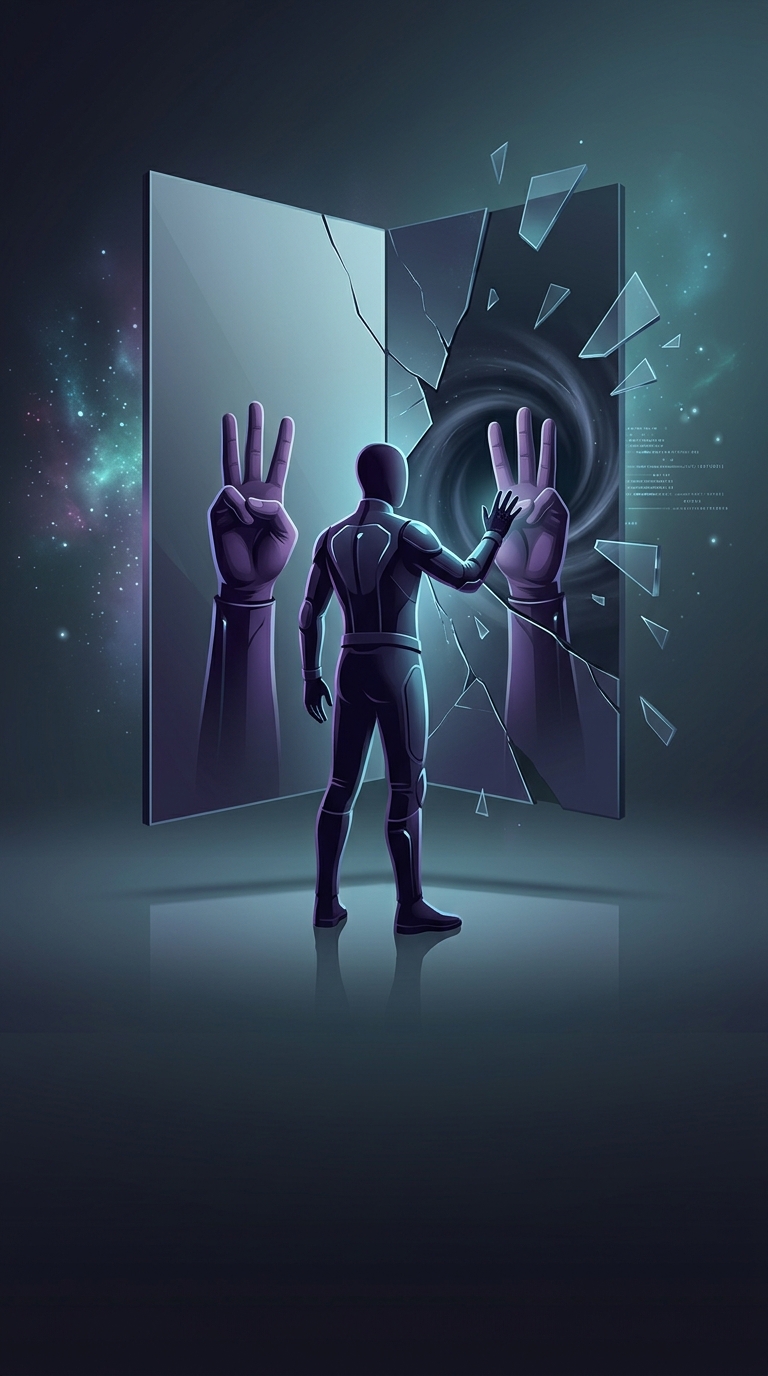
For an upright mirror, that reflection reverses the direction perpendicular to the glass—the direction from you toward the mirror. It leaves the up-and-down direction unchanged, and it leaves the side-to-side direction unchanged too. Raise your right hand, and the image’s hand on the same side of the mirror is raised.
Why the image seems to swap sides
The apparent left-right flip comes from how we interpret the image. We picture the reflected person as another person facing us, then mentally turn that person around to imagine standing in their place. A half-turn swaps left and right, so the image’s raised hand seems to be on the opposite side. But that swap comes from the imagined turn, not from the mirror.
Try writing a word on a transparent sheet and holding it up to a mirror. The letters look reversed because the sheet faces the opposite way from the image you expect to read—not because the mirror singled out left and right. Tip the sheet over, and you can change which direction the writing appears to reverse.
The mirror’s actual rule is simpler: it sends the image back through the glass, while preserving vertical orientation. That is why your reflection can keep its head above its feet even as it seems to trade sides with you.