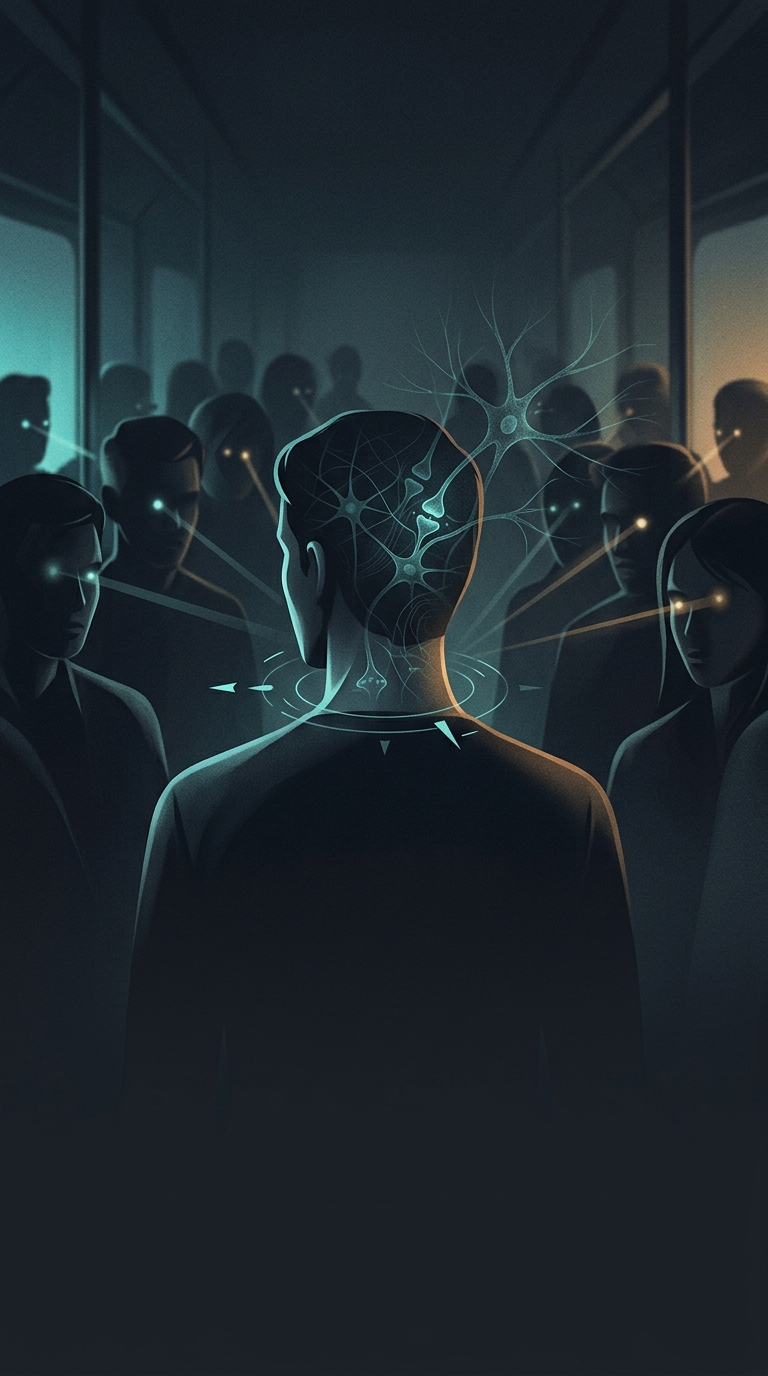
The brain is reading more than the back of your head
There is no known human sense that detects another person’s gaze through the back of the skull. But on a crowded train, you may be picking up clues without consciously noticing them: a face turning in your peripheral vision, a shift in someone’s posture, a reflection in a window, or the sound of a person moving nearby. The brain combines such fragments quickly, and the result can feel like a sudden, clear impression that someone is looking at you.
That impression is especially plausible in a packed space. People are close, moving around, and repeatedly glancing at one another to navigate. Your attention is already monitoring the surrounding crowd, even when you are focused on a phone or a book. A small cue can reach awareness only as a feeling of being watched, rather than as a detail you can identify.
Why the feeling can seem uncanny
The brain is built to notice socially important signals, including faces and attention. It also makes predictions from incomplete information: if someone turns or pauses behind you, your brain may treat that as a possible gaze before you have confirmed what happened. That quick guess can be useful for orienting yourself, but it is not proof that you sensed a stare directly.
Memory can make the experience seem more reliable, too. A moment when you turn around and meet someone’s eyes is striking and easy to remember; times you turn and nobody is looking are less likely to stick. The feeling may reflect subtle cues and a vigilant brain—not a special sense of gaze. On a train, the “signal” can be real while its source remains outside conscious awareness.