Why druid teaching stayed in memory
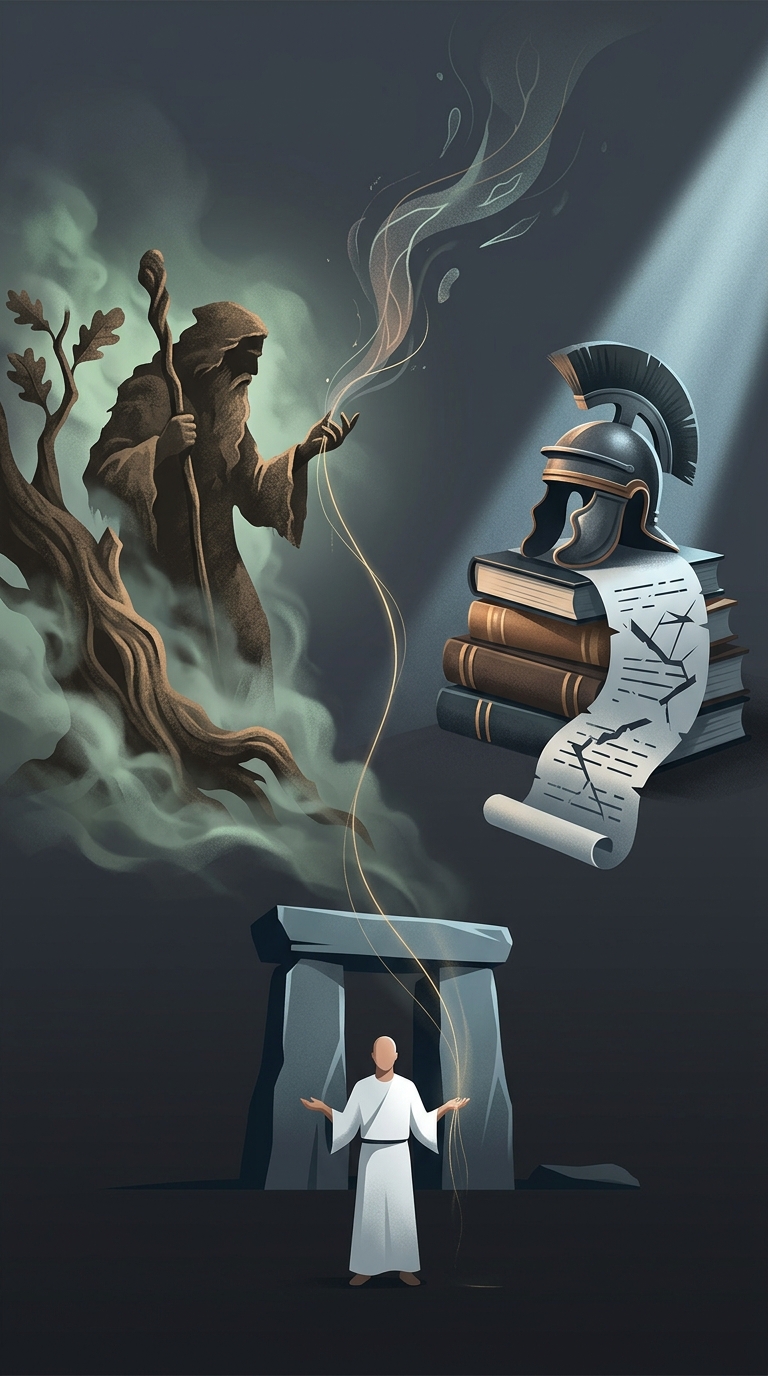
The familiar account of druids and writing comes largely through Julius Caesar, a Roman general describing the peoples of Gaul. He reported that druids taught sacred material by heart and avoided writing it down. His explanation was practical as well as religious: memorizing the teachings exercised the mind, while keeping them unwritten limited who could learn them.
That does not establish a universal law making it illegal for druids to write. The claim is narrower: according to Caesar, they did not use writing for their core teachings. He also described druids as literate in Greek letters for other purposes, suggesting that the boundary concerned what was recorded, not an absolute rejection of writing.
Memorization as a form of training
A long apprenticeship made oral teaching workable. A student had to retain complex material through repeated recitation and instruction, rather than consult a written text. Caesar says some students spent as long as 20 years in training; that figure is an ancient report, not a timetable we can verify for every apprentice.
This method also shaped who could pass on the tradition. A text can be copied and carried beyond its original teachers; knowledge held in trained memory depends on continued instruction. The result was a kind of gatekeeping built into the teaching method: apprentices needed years with experienced druids to acquire what a written page might otherwise make easier to share.
Because the teachings were not written down by their practitioners, much of what is said about them comes through outside observers such as Caesar. The striking consequence is that the same practice meant to preserve knowledge through memory also left later readers with little direct access to the words themselves.