A Door That Removed the Pause
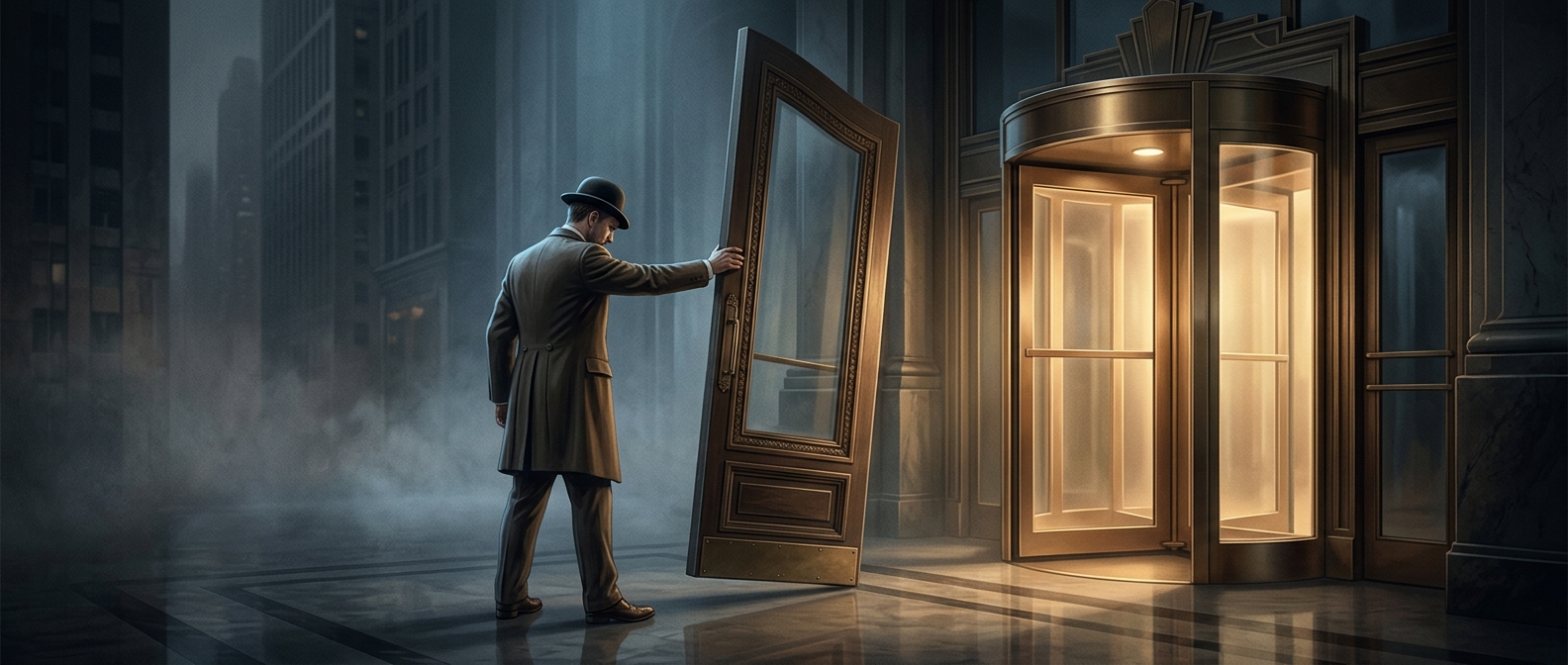
A conventional hinged door creates a small social negotiation: someone approaching from the other side may wait, step back, or hold it for the person behind. Theophilus van Kannel’s revolving-door design changed that encounter. Instead of one person controlling a swinging panel, each visitor could push the rotating panels through the doorway and keep moving.
That mattered in busy entrances, where holding a heavy door could interrupt the flow of people as well as impose a brief obligation on strangers. The design did not eliminate courtesy, but it made passage less dependent on one person stopping to provide it.
How Rotation Kept the Air Inside
A revolving door divides its circular space into compartments with vertical panels. As a person pushes, the panels turn around a central spindle, carrying the visitor from one side to the other. The doorway is rarely open straight through: the panels remain close to the surrounding walls, limiting the amount of indoor and outdoor air that can rush past each other.
A hinged door, by contrast, swings open a broad passage. In cold or windy weather, that opening can let a gust into a building; when air conditioning is running, it can also let cooled air escape. The revolving door’s compartments reduce that exchange while still allowing people to enter and leave.
A Social Fix With a Practical Payoff
Van Kannel’s invention joined two advantages in the same mechanism. It eased a familiar point of awkwardness at the entrance while also helping buildings hold onto their indoor temperature. The memorable part is that the door’s energy-saving effect came from its basic motion: people could keep moving, but the building did not have to open itself as widely to let them through.