Borrowing a Vacuum’s Airflow
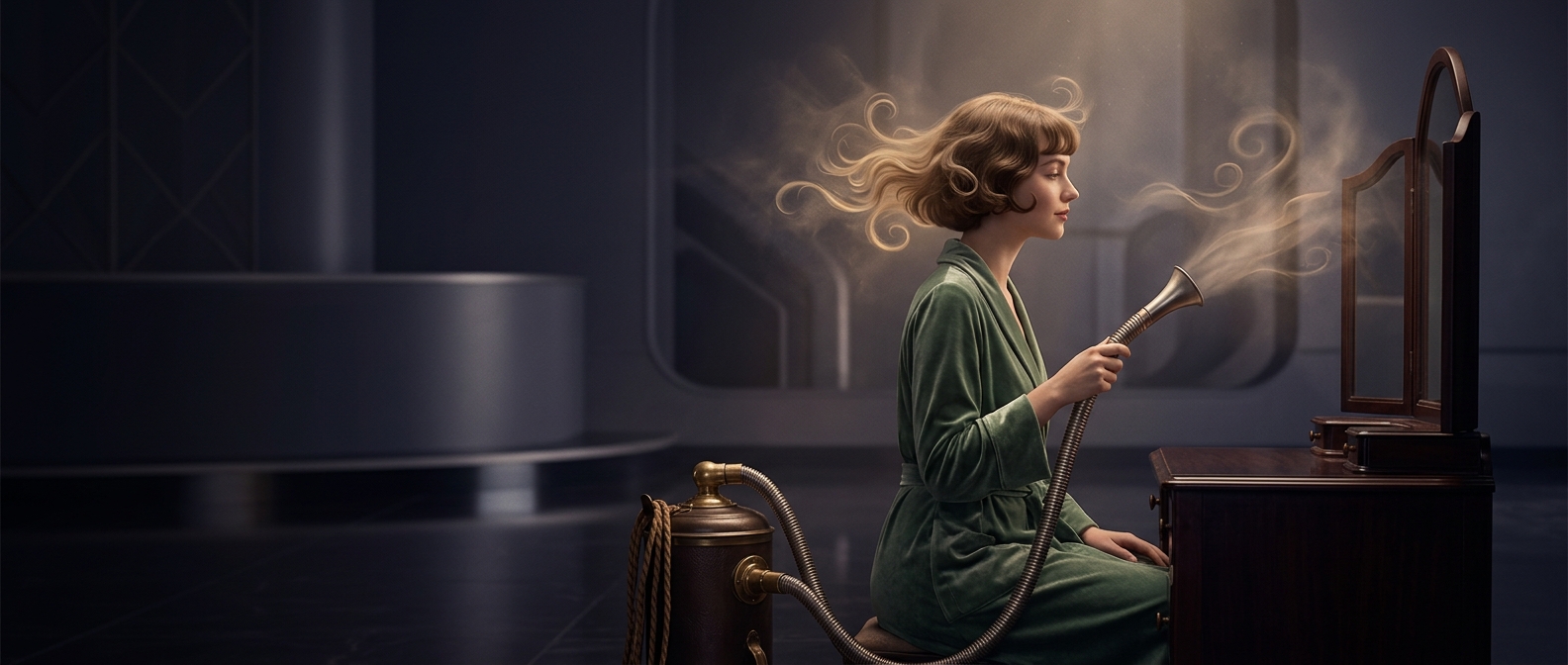
A vacuum cleaner’s motor does more than create suction. It pulls air through the machine, then pushes that air back out through an exhaust opening. On some models, a hose could be fitted to that outlet instead of the inlet, turning the machine’s usual stream of incoming air into a stream aimed at the user.
Because air passing through a running motor picked up some heat, the exhaust could help dry wet hair as well as move it. The attachment did not make the vacuum a purpose-built hair dryer: it redirected airflow the machine already produced.
A Useful Shortcut, With Limits
Early electric hair dryers were often too bulky to hold comfortably, so using a vacuum offered a practical workaround: the heavy motor could stay on the floor while a hose brought air to the person drying their hair. It was a clever use of a household appliance already plugged in, but the warmth was incidental, not carefully controlled for hair drying. The vacuum’s exhaust could also carry dust if the machine was dirty or poorly maintained.
The arrangement points to a familiar step in appliance history: before a tool became compact and specialized, people could adapt a larger machine to do the job. A hose and the right outlet made a vacuum briefly serve as both cleaner and dryer.