How a Spinning Disc Turned a Scene Into a Picture
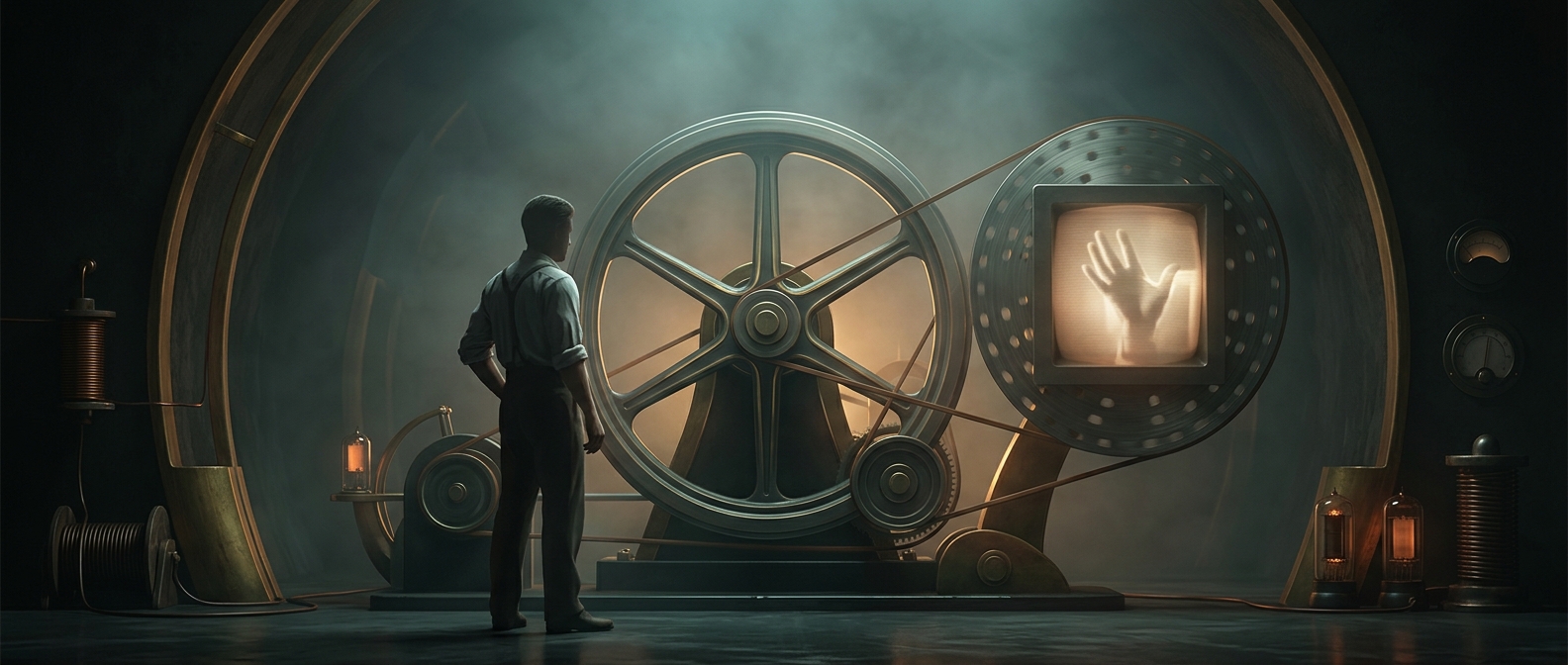
A mechanical television did not capture an entire image at once. In a common design, a lens focused the scene onto a spinning disc whose holes sat at different distances from its center. As the disc rotated, each hole swept across the scene in turn, sampling a narrow strip from top to bottom. Together, the strips formed a picture line by line.
At the transmitting end, a light-sensitive cell converted the changing brightness in each tiny sampled area into an electrical signal. The signal carried the pattern of light and dark—not a finished picture—to a receiver.
The Receiver Had to Keep Time
A matching rotating disc at the receiver turned in step with the one at the transmitter. Behind its holes, a lamp varied in brightness according to the incoming signal. Each hole revealed a small part of the image at the right moment; the viewer’s eye blended the rapidly changing points into a recognizable scene.
That timing was crucial. If the two discs fell out of sync, the picture could slide or distort because the receiver would show each strip in the wrong place. The system was therefore not just a spinning gadget: it depended on coordinated motion and a signal that changed in precise relation to that motion.
Why the Pictures Looked So Rough
The number and arrangement of holes limited how many lines the system could scan. With relatively few lines, fine detail disappeared, leaving broad shapes and silhouettes. The image also had to be rebuilt repeatedly, and the mechanical scanning could make it flicker rather than appear steady.
The design’s ingenious trick was to trade a complicated camera for a moving sampler. But its picture was constrained by the physical disc: adding more detail meant fitting more precise scanning steps into a device that had to spin smoothly and stay synchronized.