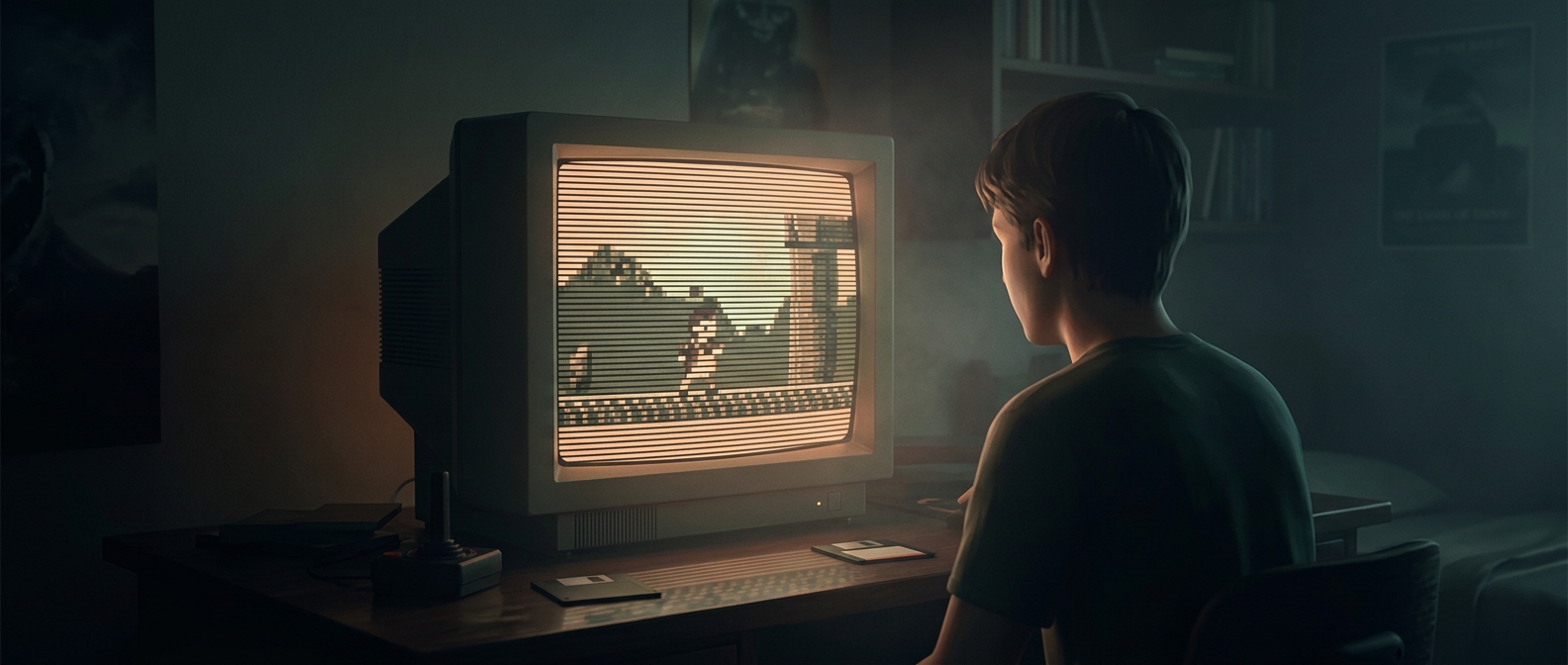
The display was part of the artwork
A CRT did not draw a fixed grid of square pixels. An electron beam swept across the screen, exciting tiny phosphor dots that glowed briefly. The beam’s spot was not perfectly sharp, and the phosphor glow spread slightly beyond each hit. As a result, adjacent bright and dark areas blended at the viewing distance, smoothing stair-stepped outlines and making clusters of colored pixels read as a single shape.
That mattered because many games were made for the whole display chain, not just for the console’s raw pixel output. On common analog connections, color and brightness information could bleed into nearby areas. Designers could exploit that softness: alternating pixels might suggest a shade between two available colors, while a carefully placed highlight could appear to blend into a rounded form.
Why the same pixels look different now
A modern flat-panel screen maps the game’s image onto a sharply defined grid. If each original pixel is enlarged into a crisp square, the old transitions become more obvious: a curve looks like steps, and patterns once softened by the display can look like harsh stripes. The game has not changed; the optical and signal effects that helped shape its appearance have.
That is why retro-game displays and emulators sometimes add scanlines, blur, or color blending. Used carefully, these effects approximate the conditions the artists were designing around—not as decoration, but as part of how the image resolved into a recognizable scene.