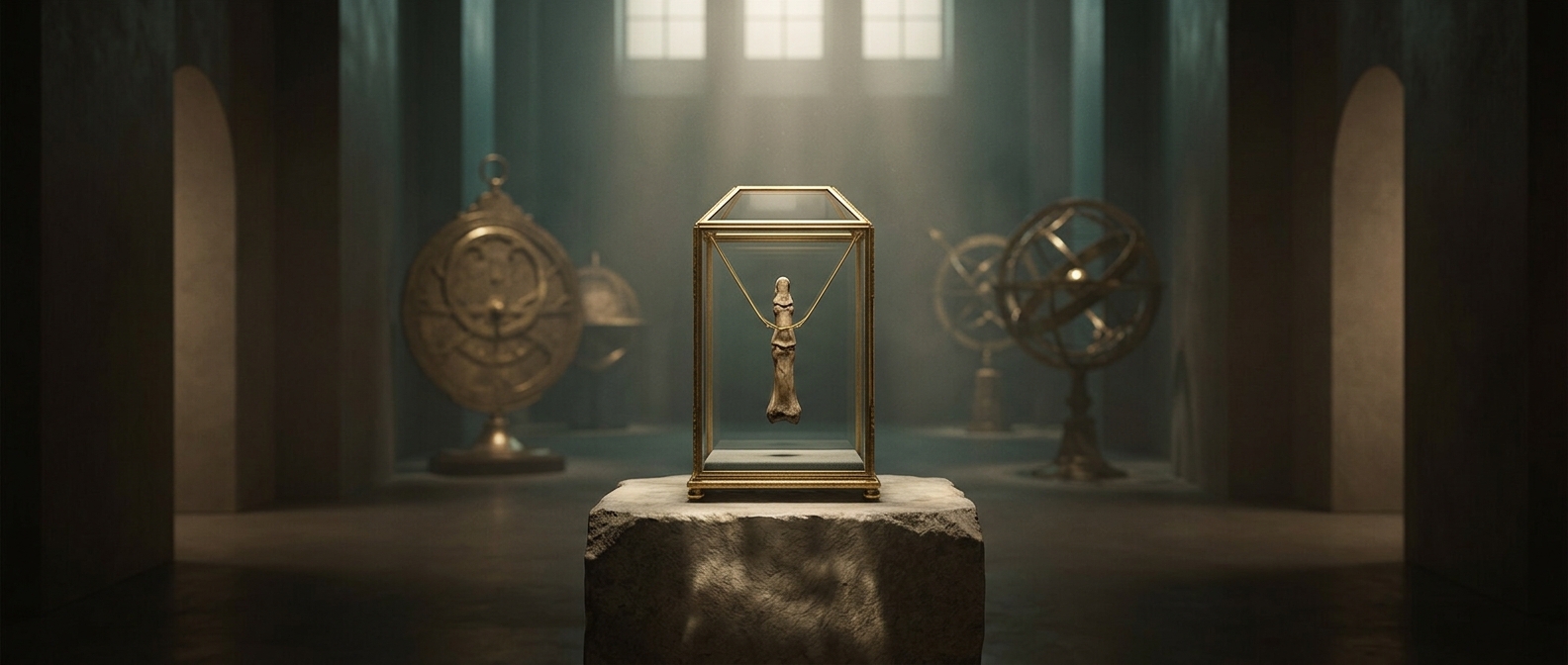
From Restricted Burial to Monumental Tomb
Galileo died in 1642 while still under the Catholic Church’s sentence for supporting Earth’s motion around the Sun. He was buried at Santa Croce in Florence, but not initially in the grand tomb that later became his public memorial. In 1737, his remains were moved to a prominent new monument inside the church. The transfer turned a change of burial place into a chance for admirers to claim physical mementos.
Why Keep a Finger?
Collecting relics—pieces of a revered person’s body or possessions—was a longstanding way to make remembrance tangible. Galileo’s admirers removed three fingers during the transfer. The middle finger, preserved upright in a glass vessel, can look like a deliberate insult today. But its display belongs to the history of relics: the body part was kept as a connection to a celebrated thinker, not as a gesture directed at the Church.
A Change in Galileo’s Public Meaning
The memorial and the relics reflect a shift in how Galileo was remembered. During his lifetime, his astronomical arguments brought him into conflict with religious authorities; decades later, admirers could honor him openly with a monumental tomb. His finger makes that change unusually concrete: a fragment once taken from a body during reburial became an object preserved for public viewing. The pointed pose now gives visitors an unexpected encounter with the distance between Galileo’s condemnation and his later fame.