Why Halley’s comet speeds up near the Sun
Halley’s orbit is a stretched oval, not a circle. The Sun’s gravity continually bends the comet’s path, but its pull is strongest when Halley is close. As the comet falls inward, it accelerates; after rounding the Sun, it slows as it climbs back outward. This is the same gravitational tradeoff that sends a ball thrown upward fast at first and then progressively slower, though Halley’s journey spans the solar system.
Sunlight turns a dark nucleus into a visible comet
Far from the Sun, Halley is a small, frozen body that reflects little light. Near the Sun, its surface warms and some of its ice turns directly into gas—a change called sublimation. The escaping gas carries dust with it, building a hazy cloud around the solid nucleus. Sunlight and the stream of charged particles flowing from the Sun push material away, forming tails that point generally away from the Sun rather than simply trailing behind the comet’s motion.
That temporary activity is why the comet becomes easier to see on its inward passage. It is not a sudden transformation into a bright object: visibility also depends on how much gas and dust it releases, where Earth is in relation to the comet, and how dark the sky is. A return to the inner solar system can therefore be a striking sight without guaranteeing that every observer sees an equally bright display.
A pass that reshapes the next long journey
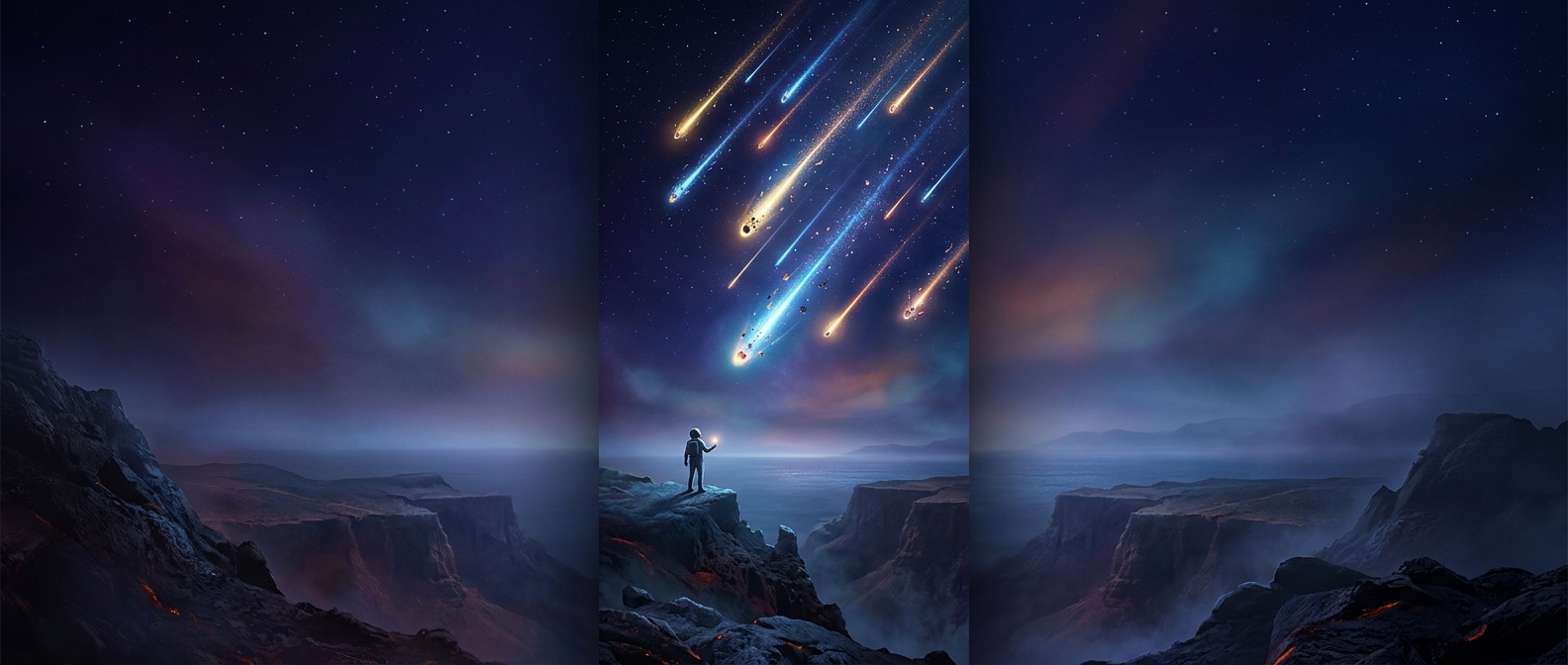
Each close approach sheds some material, gradually changing the comet’s surface and leaving dust along its route. Earth can cross parts of that dusty trail, producing the Orionid meteor shower. Halley’s brief, active passage thus has an afterlife: debris released near the Sun can become visible from Earth long after the comet itself has receded into the dark.