A wave can grow without gaining a single new source of energy
Ocean waves are not isolated ridges moving across a flat surface. They travel in groups, and each wave is a combination of many smaller motions. When crests line up, their up-and-down movements reinforce one another—a process called constructive interference. The unusually high crest is temporary: as the waves move on, their timing shifts and the peak usually subsides.
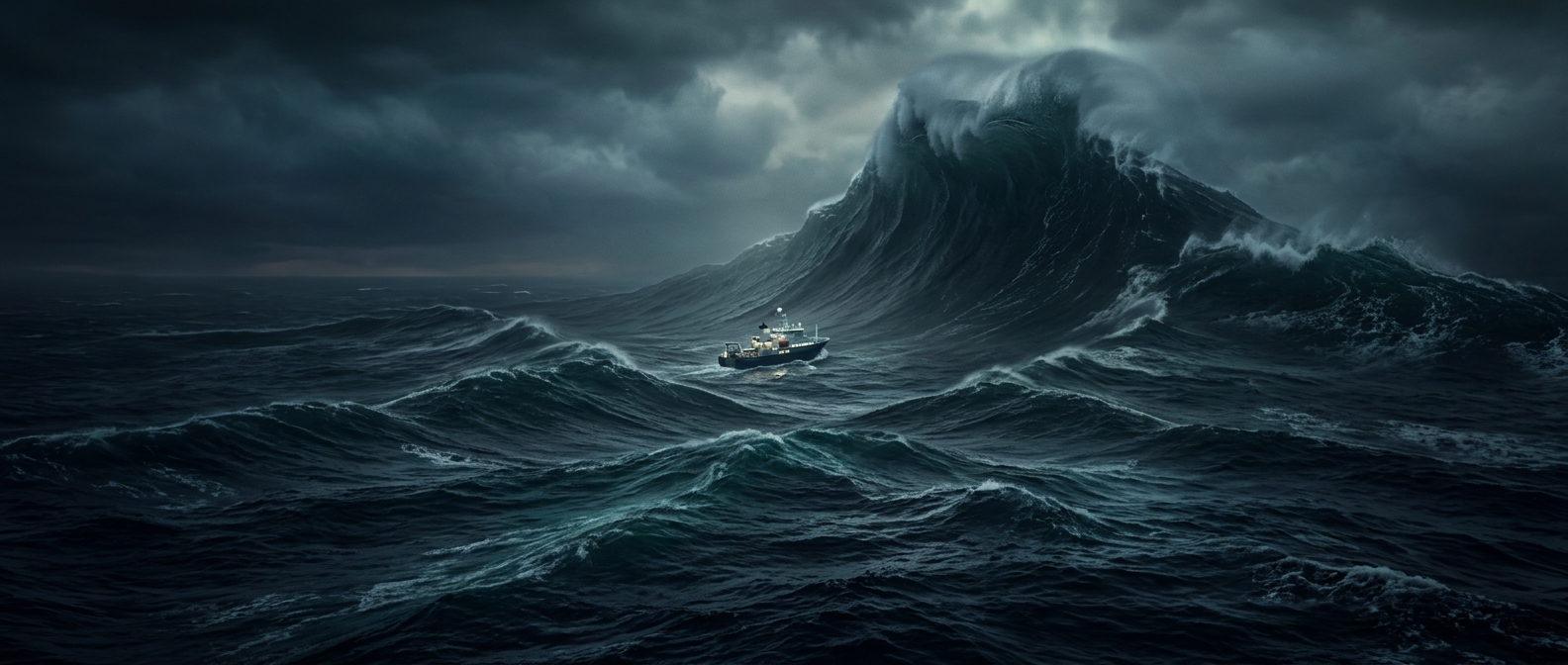
That overlap helps explain how a rogue wave can rise far above the surrounding sea without a storm suddenly producing one giant wave from scratch. “Rogue” is a relative description: the wave is strikingly larger than the waves around it, not simply large by some universal height standard.
Currents can change the timing
A current can make waves converge or slow against the flow. When waves bunch together, their energy is concentrated into a shorter stretch of ocean, much as traffic compresses when a road narrows. The result can be steeper, taller waves in one area while nearby water remains less dramatic.
Waves can also interact in ways that redistribute their energy. These effects are complex, and no single mechanism explains every rogue wave. In some conditions, a group of waves may intensify through interactions among its members; in others, current-driven focusing can play a larger role.
Why the danger is hard to predict
Because the peak depends on waves meeting in the right place and moment, a rogue wave may appear between more ordinary crests rather than announcing itself as a steadily building swell. Its height can change over a short distance, making local conditions matter as much as the broader sea state. A vessel can therefore encounter an exceptional wall of water even when the surrounding waves do not look exceptional—an abrupt consequence of several ordinary processes lining up.