How a Diplodocus tail could make a boom
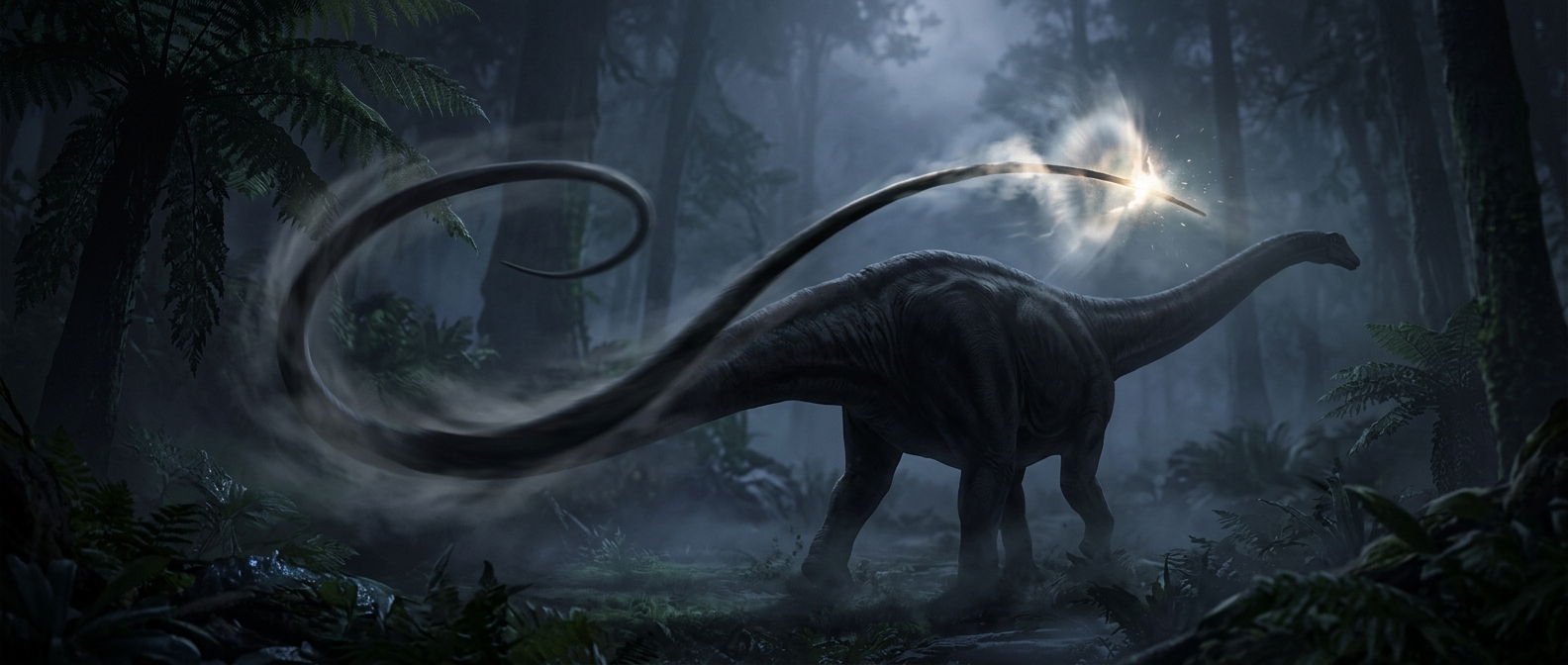
A Diplodocus had a long, tapering tail: thick near the hips, then narrowing into a slender tip. If the animal whipped it sideways, movement could travel down that narrowing shape much like a wave traveling along a whip. As the tail’s mass decreased toward its end, the tip could move faster than the heavier base.
If the tip crossed the speed of sound, it would create a sonic boom—a pressure wave produced when something moves through air faster than sound can travel. The sharp crack of a hand whip works on the same basic principle: the tip accelerates dramatically and briefly becomes supersonic.
A plausible mechanism, not a proven performance
The idea comes from the tail’s shape and from mechanical models of how a flexible, tapering structure can accelerate a wave toward its tip. But fossils preserve bones, not the muscles, tendons, and soft tissues that controlled a living tail. They cannot reveal exactly how quickly Diplodocus could swing it, or how much force its tail could withstand.
That matters because the tail was not simply a whip made of bone. Its vertebrae had to move through joints, and the surrounding tissues had to transmit force without failing. A model can show that a supersonic tip is physically possible under certain assumptions; it cannot by itself establish that the animal routinely achieved one.
Speed may have come with a cost
A tail moving fast enough to make a boom would also experience substantial stress. Some studies have suggested that a supersonic swing could damage the tail, making the spectacular crack a risky maneuver rather than a harmless trick. The animal may have been able to produce a powerful, fast swing without reaching that extreme—or the tail’s limits may have constrained how often it could do so.
The striking possibility, then, is not just that a giant dinosaur could make a whip-like crack. It is that the same thin, flexible tail that could accelerate its tip may also have set a limit on how hard it was safe to swing.