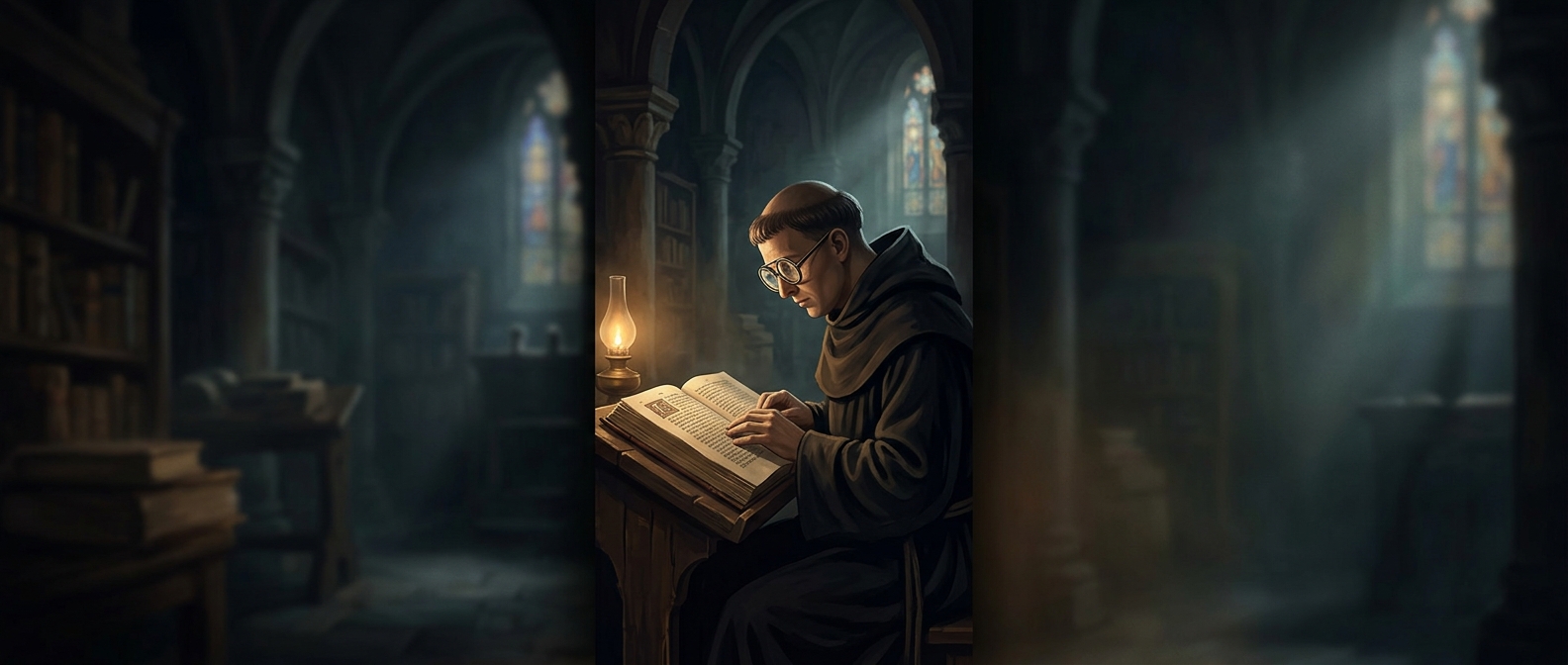
Why reading made monks natural early customers
A manuscript was not simply a book to glance through. Copying one meant keeping the eyes on small, closely spaced letters for long stretches, often in dim rooms. As people aged, many found near work harder: the eye’s lens becomes less flexible, so it cannot focus as easily on nearby text. For a monk whose work depended on reading, that change could interfere with a daily task.
What an early spectacle lens did
The first spectacles, appearing in Europe in the late 13th century, generally used convex lenses—lenses thicker at the center than at the edges. They bend light so that nearby letters can be focused more clearly by an aging eye. They did not magnify in the same convenient, adjustable way as modern reading glasses: early lenses were thick, and frames were often joined at the bridge and balanced on the nose rather than held in place by arms over the ears.
The idea built on a simpler aid: a rounded, transparent “reading stone” placed over a page to enlarge its letters. Spectacles made that help wearable, leaving both hands free to hold a book or work with a pen.
A practical tool for a reading culture
Monasteries were among the places where sustained reading and manuscript work were concentrated, so monks had an obvious reason to adopt a device that made close vision easier. They were not the only possible users, and spectacles did not instantly solve every vision problem; early lenses mainly helped people who struggled to see nearby text. But for a reader bent over a manuscript, even a modest improvement could mean continuing the work without bringing the page closer to the face.