A Mathematical Claim Reached the Indiana Statehouse
In 1897, Indiana lawmakers considered a bill built around an ambitious claim: that a circle could be “squared”—that is, that a square with exactly the same area could be constructed using only a compass and straightedge. The problem had resisted such a construction for centuries. The bill’s proposed method relied on mathematical assertions that did not hold up, including a value of pi often summarized as 3.2.
That summary captures the episode’s absurdity, but the bill was not simply a clean proposal to replace pi with a new number. Its long, confusing text presented supposed geometric results and related numerical claims. A legislature could endorse the text, but it could not make those results true.
The Professor Who Read the Bill
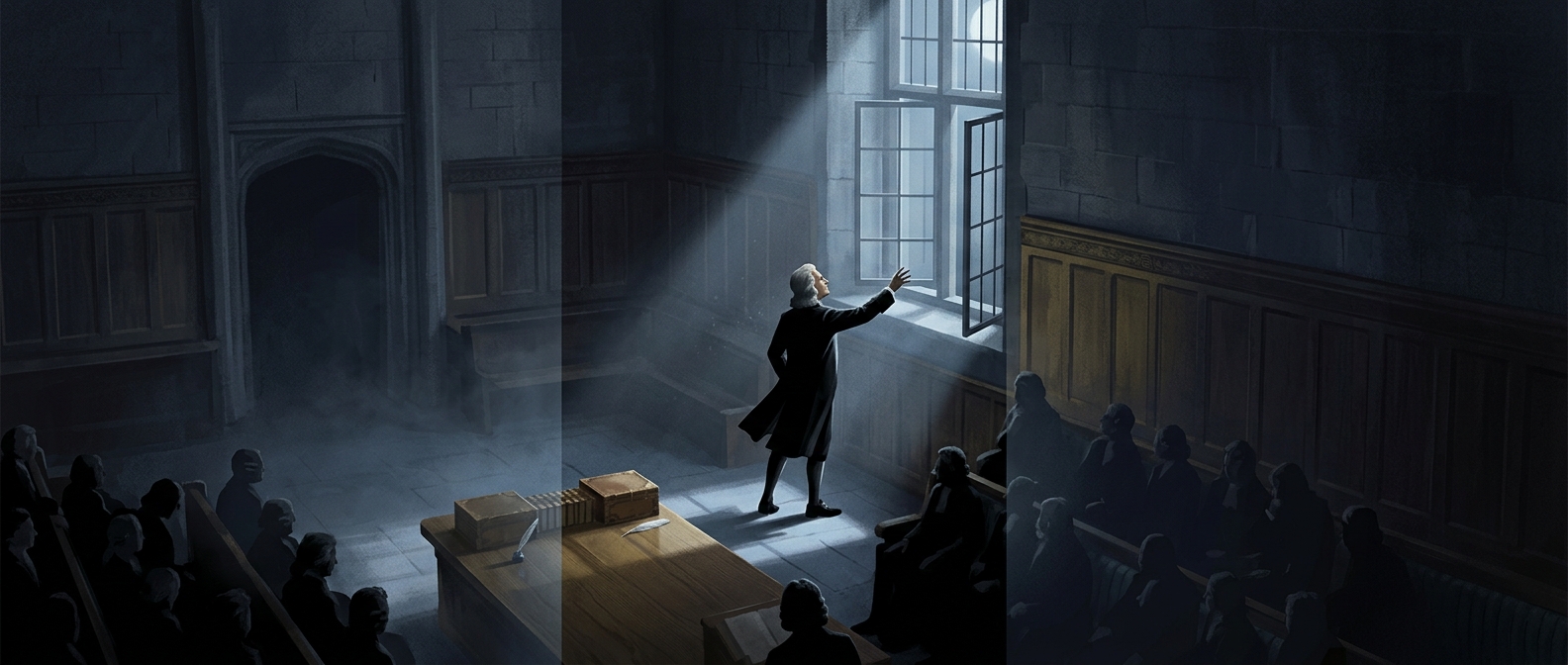
Mathematics professor Clarence Waldo was at the Statehouse on other business when he encountered the proposal. He examined its claims and explained to lawmakers that the construction was impossible as stated. The bill had already passed the Indiana House; after Waldo’s intervention, the Senate set it aside rather than advancing it.
The key issue was not whether lawmakers had authority to change a mathematical constant. They did not. The danger was that a legislative endorsement could lend official credibility to an invalid proof and make a mathematical error look like settled fact.
Why the Proposal Failed
A proof must work at every step, not merely produce a plausible-looking diagram or a convenient number. The bill’s reasoning did not establish the promised construction, and its numerical claims could not repair that failure. In modern terms, the goal of squaring the circle with compass and straightedge is impossible because pi is transcendental: it cannot be the solution of any polynomial equation with rational-number coefficients, as such a construction would require.
The episode survives as a comic tale about legislators nearly voting on mathematics. Its sharper lesson is practical: when a technical claim enters public policy, someone who can test the reasoning may matter as much as the vote itself.