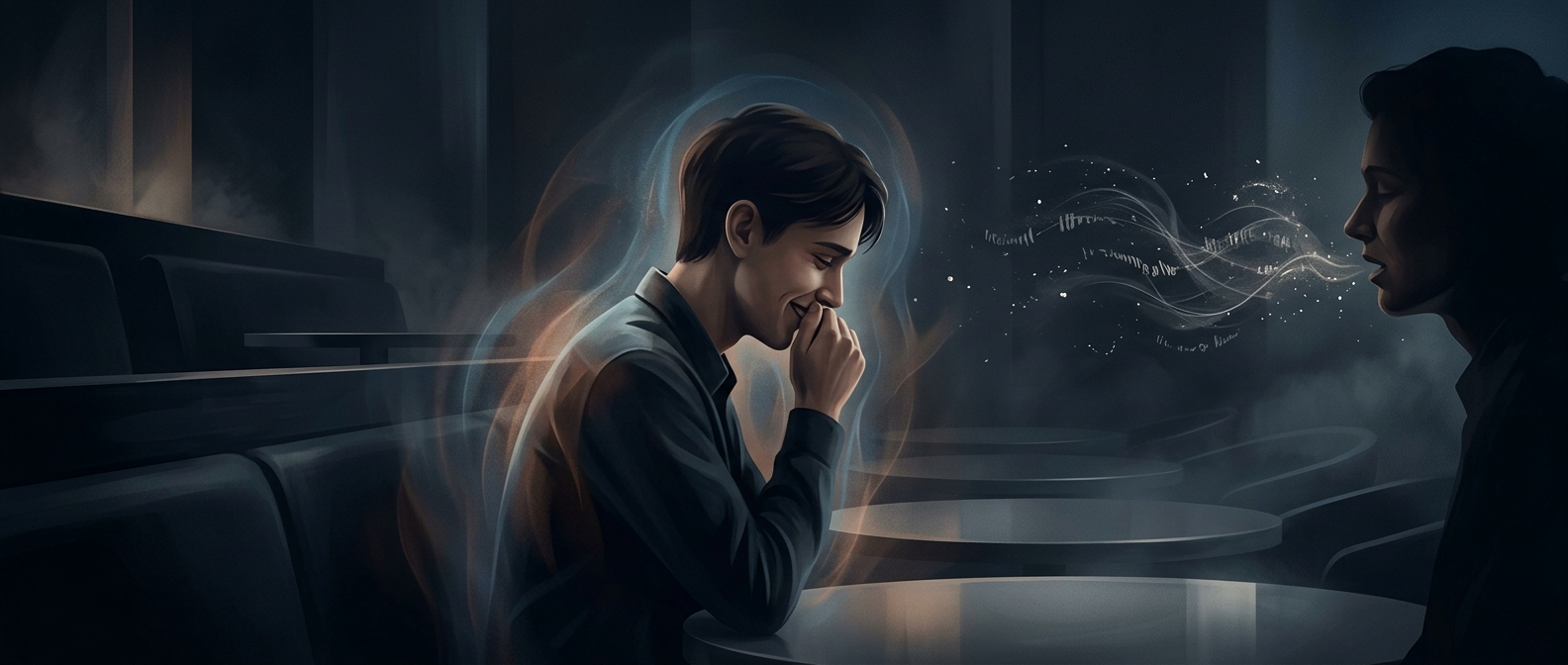
When laughter fills a gap in conversation
A laugh can do more than express amusement. In a conversation, it can work as a social signal: I’m with you, and I mean no harm. When you miss a word or aren’t sure how to respond, a brief laugh may keep the exchange warm while you catch up. It buys a moment without forcing you to interrupt immediately.
Why the signal can backfire
Conversation moves quickly, and people constantly infer meaning from small cues—tone, facial expression, pauses, and laughter. If you laugh after someone speaks, they may read it as evidence that you understood and found something amusing. That interpretation gives them a reason to continue rather than explain or repeat themselves.
The mismatch is subtle: you meant, “I’m keeping this friendly while I figure out what you said”; the speaker may hear, “I got it.” The laugh can therefore smooth over uncertainty for a moment while making the underlying misunderstanding harder to catch.
A small clarification changes the course
If the missing information matters, pairing warmth with a direct request is clearer: “Sorry, I missed the last part—could you say it again?” That makes your uncertainty visible without treating it as a social failure. A laugh can preserve the mood, but it cannot tell the other person that you need a repeat.
The practical consequence is simple: when you laugh to cover a gap, the conversation may keep moving on the assumption that there was no gap at all.