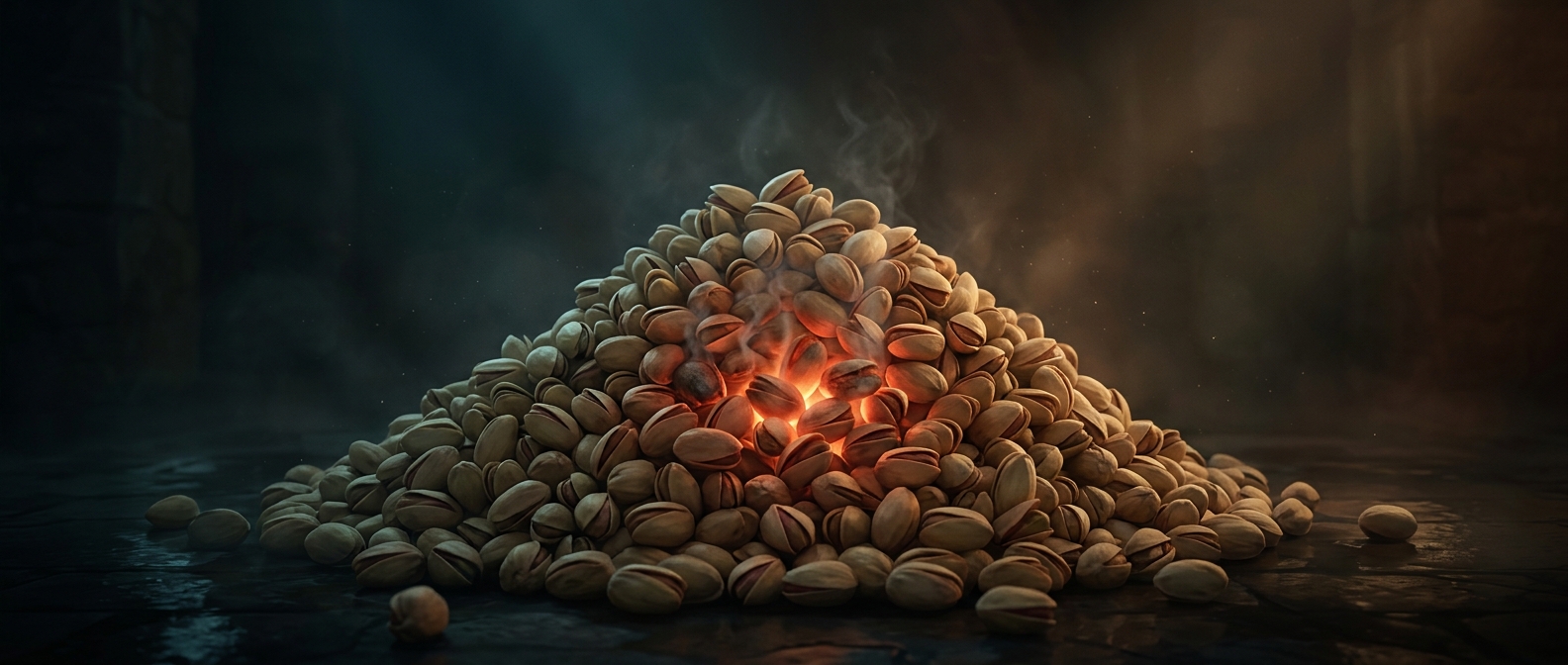
How a pile of pistachios can heat itself
A large mass of pistachios can retain heat in its center even when the surface feels cool. The kernels contain oils that slowly react with oxygen in the air. That reaction releases a little heat. In a small amount, the heat escapes; in a tightly packed bulk, kernels deep inside are insulated by the surrounding material, so heat can accumulate.
A slow process can become a fire
As the pile warms, the oil’s oxidation can speed up, producing heat faster. If the center gets hot enough, the kernels may begin to smolder and eventually ignite. No match or spark is required: the energy comes from chemical reactions within the stored material. This is called spontaneous combustion, meaning ignition caused by heat building up inside a material rather than by an external flame.
The key is the balance between heat made and heat lost. A smaller or looser pile can shed heat more readily; a dense mass holds it in. Moisture and other storage conditions can also affect how quickly a stored crop warms, so the risk depends on more than the fact that pistachios contain oil.
Why the center matters
Self-heating can be hard to spot early because the outside may remain much cooler than the interior. That makes bulk storage a different problem from keeping a handful of nuts in a bowl: in a large pile, heat has a long path to travel before it can escape. The surprising consequence is that a food associated with cool, dry storage can become its own heat source when enough of it is packed together.