How a river current rounds a sheet of ice
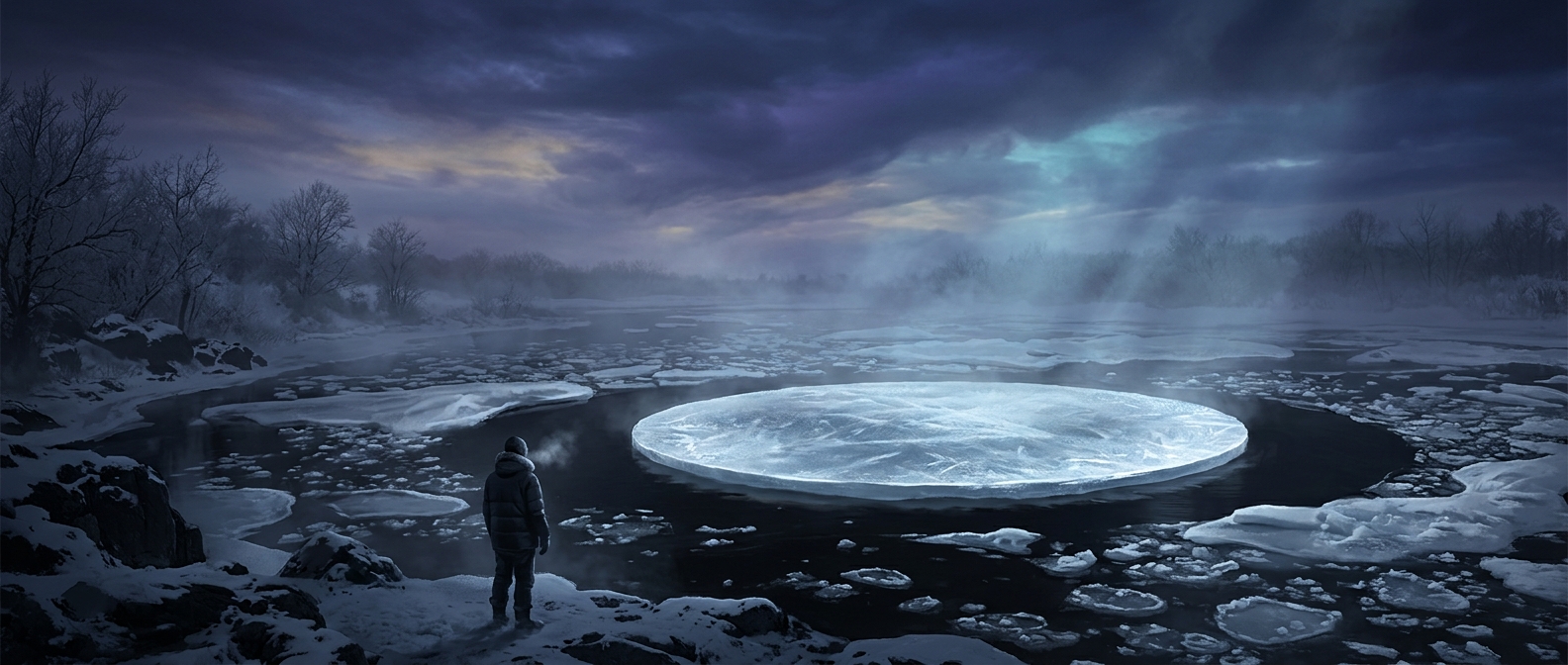
An ice circle often begins as a less orderly piece: a thin sheet or cluster of newly formed ice caught in a slow-moving whirlpool. The whirlpool is a rotating current, or eddy. It carries the ice around while water and nearby ice press against its edges.
That repeated motion gradually wears the edges down. The disc may bump and scrape against the surrounding ice or riverbank, while its own rotation helps expose its perimeter to friction. Over time, corners disappear and the piece becomes rounder. A smooth circle is therefore not necessarily frozen in that shape; it can be shaped by many turns in moving water.
Why the circle can keep turning
The eddy supplies the force that spins the disc, while the river’s flow helps keep the ice moving rather than locking it in place. The balance depends on local conditions: water speed and direction, the shape of the riverbed and banks, and how much loose ice is present. When the current weakens or the ice becomes lodged against a fixed edge, the rotation can slow or stop.
Ice circles are thus a visible trace of water moving beneath a surface that appears still. Their neat outlines can look deliberately made, but the shaping comes from a simple interaction: rotating water carries the ice, and repeated contact trims its uneven edges.