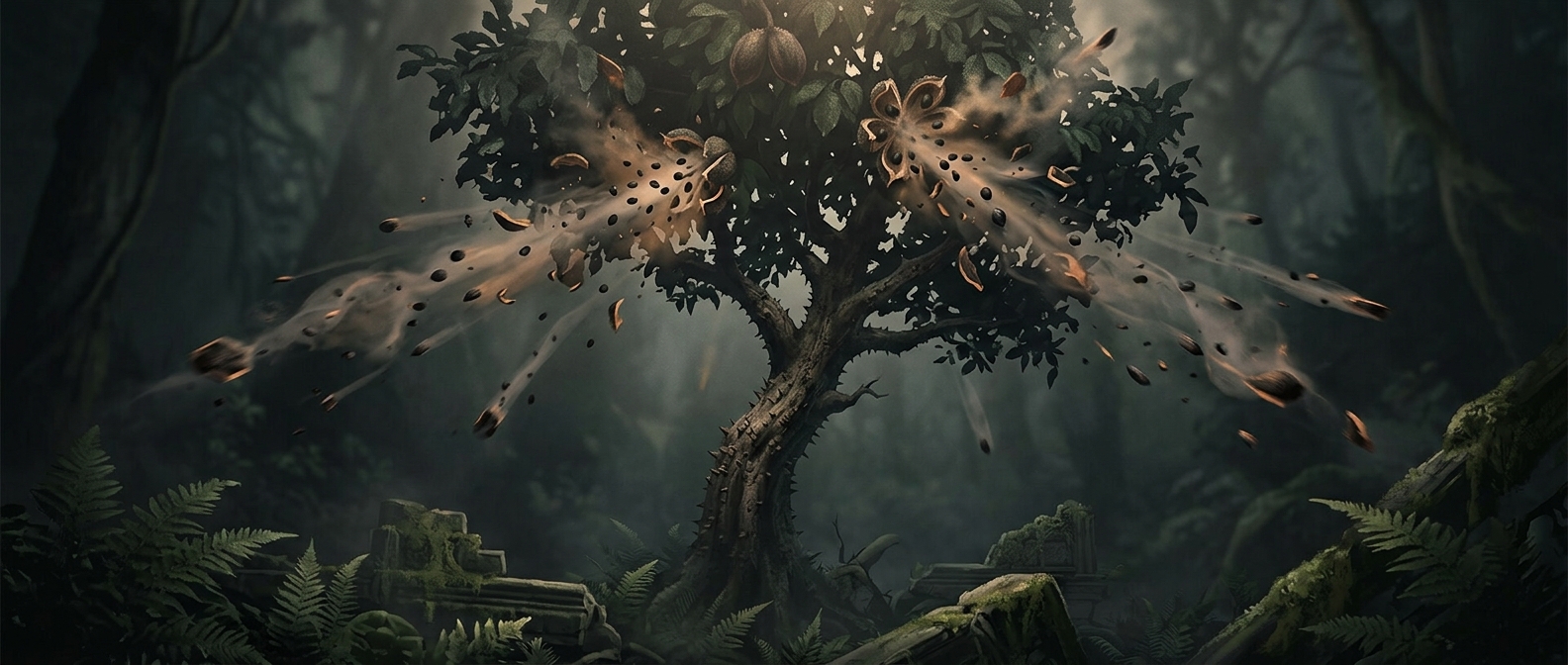
How a drying seed pod becomes a spring
Some trees disperse seeds with a sudden mechanical release. As a pod dries, its walls shrink, but they do not all shrink in the same direction or at the same rate. That uneven change makes the walls bend and twist, storing elastic energy—much like a strip of material that curls as it dries.
The pod’s seam holds the strained walls together until it can no longer resist. Then the pod splits, and the walls rapidly curl or spring apart. The flat seeds are caught in that movement and launched outward. The tree supplies no muscle power: the energy comes from the pod’s gradual drying and is released in a fraction of a second.
Why launch seeds at all?
Seeds that land directly beneath their parent tree may have to compete with it for light, water, and space. A sudden launch can scatter them into nearby gaps where a seedling has a better chance to grow. It is a way to move seeds without relying on an animal to eat or carry them.
The mechanism also ties dispersal to weather. A pod can build tension while drying and open when conditions are right for it to split. What looks like a tiny plant-made catapult is therefore a stored-energy system: slow changes in moisture prepare the pod, and the seam’s failure turns that stored strain into a brief, forceful burst.