How sunlight pushes a spacecraft
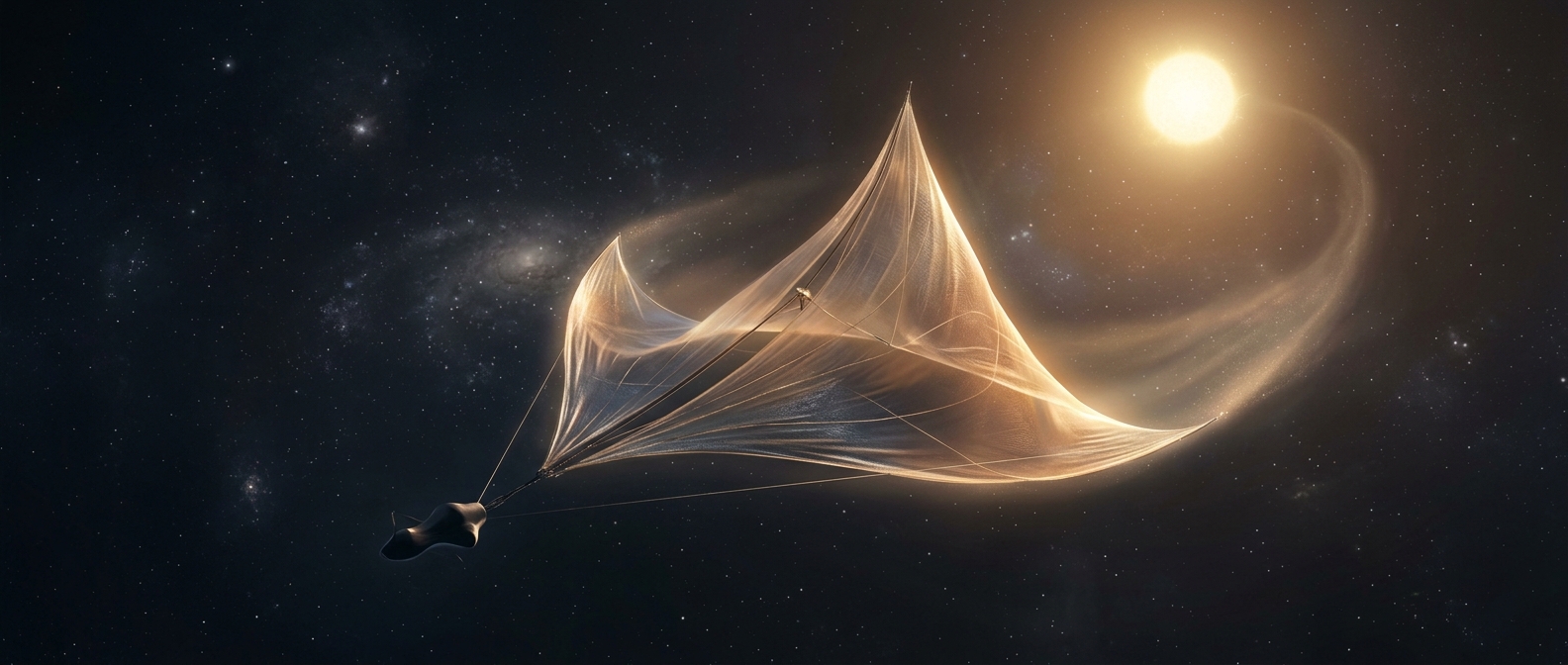
Sunlight may seem weightless, but light carries momentum—the same physical property that lets a moving object deliver a push. When photons, the particles of light, strike a reflective sail and bounce away, their momentum changes direction. That change gives the sail a small push in the opposite direction.
The force is slight because each photon carries very little momentum. A solar sail makes it useful by spreading a large, lightweight reflective surface into the sunlight and letting the photons keep arriving. The pressure is greatest close to the Sun, where the light is more intense, and falls as the spacecraft travels farther away.
Steering with the light
A sail’s thrust depends on how it faces the Sun. Turning it changes how much sunlight hits the surface and the direction of the push, allowing a spacecraft to adjust its path. The sail does not simply catch a fixed wind: sunlight supplies the force, while the spacecraft’s orientation determines how that force is used.
Because the push continues without propellant, a solar sail can build up speed over time. It cannot provide the sudden, powerful acceleration of a chemical rocket, and it still needs a rocket or another method to get into space. But once deployed, its broad surface can turn an ongoing stream of sunlight into motion—trading a brief burst of fuel for a much gentler push that keeps adding up.